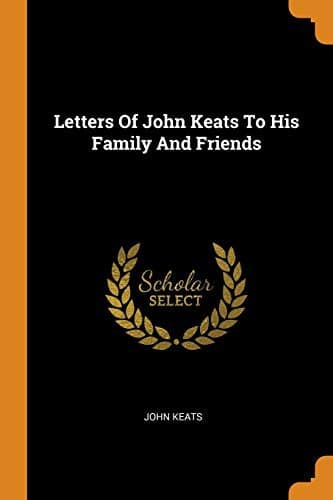
Letters of John Keats to His Family and FriendsKeats, John
General
Letters of John Keats to His Family and Friends
Keats, John
Keats, John, 1795-1821 -- Correspondence; Poets, English -- 19th century -- Correspondence
My dear Fanny--I called on Mr. Abbey in the beginning of last Week: when
he seemed averse to letting you come again from having heard that you had
been to other places besides Well Walk. I do not mean to say you did
wrongly in speaking of it, for there should rightly be no objection to
such things: but you know with what People we are obliged in the course of
Childhood to associate, whose conduct forces us into duplicity and
falsehood to them. To the worst of People we should be openhearted: but it
is as well as things are to be prudent in making any communication to any
one, that may throw an impediment in the way of any of the little
pleasures you may have. I do not recommend duplicity but prudence with
such people. Perhaps I am talking too deeply for you: if you do not now,
you will understand what I mean in the course of a few years. I think poor
Tom is a little Better: he sends his love to you. I shall call on Mr.
Abbey to-morrow: when I hope to settle when to see you again. Mrs. Dilke
has been for some time at Brighton--she is expected home in a day or two.
She will be pleased I am sure with your present. I will try for permission
for you to remain here all Night should Mrs. D. return in time.
Your affectionate Brother
JOHN ----.
LXXVI.--TO RICHARD WOODHOUSE.
[Hampstead, October 27, 1818.]
My dear Woodhouse--Your letter gave me great satisfaction, more on account
of its friendliness than any relish of that matter in it which is
accounted so acceptable to the "genus irritabile." The best answer I can
give you is in a clerklike manner to make some observations on two
principal points which seem to point like indices into the midst of the
whole pro and con about genius, and views, and achievements, and ambition,
et caetera.--1st. As to the poetical Character itself (I mean that sort, of
which, if I am anything, I am a member; that sort distinguished from the
Wordsworthian, or egotistical Sublime; which is a thing per se, and stands
alone,) it is not itself--it has no self--It is everything and nothing--It
has no character--it enjoys light and shade; it lives in gusto, be it foul
or fair, high or low, rich or poor, mean or elevated--It has as much
delight in conceiving an Iago as an Imogen. What shocks the virtuous
philosopher delights the chameleon poet. It does no harm from its relish
of the dark side of things, any more than from its taste for the bright
one, because they both end in speculation. A poet is the most unpoetical
of anything in existence, because he has no Identity--he is continually in
for and filling some other body. The Sun,--the Moon,--the Sea, and men and
women, who are creatures of impulse, are poetical, and have about them an
unchangeable attribute; the poet has none, no identity--he is certainly
the most unpoetical of all God's creatures.--If then he has no self, and
if I am a poet, where is the wonder that I should say I would write no
more? Might I not at that very instant have been cogitating on the
Public-domain text, read in full here on John Shaqi.
Reviews
Reviews
No reviews yet
Be the first to share your thoughts on this work.
Elsewhere in the archive
Join the Discussion
Join the discussion
Sign in to leave a comment or review.
Sign InorCreate an account