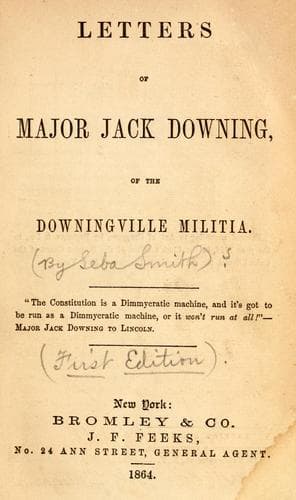
Letters of Major Jack Downing, of the Downingville MilitiaSmith, Seba
History
Letters of Major Jack Downing, of the Downingville Militia
Smith, Seba
Lincoln, Abraham, 1809-1865 -- Caricatures and cartoons; United States -- History -- Civil War, 1861-1865 -- Humor
war at all; but," ses I, "while the South have had a single end an
purpose, we've been all at odds and ends. The war has been carried on
by us jest like old Sol Pendergrast's boy ploughed. Old Sol took his
oldest boy, Adam, a thick-heded feller, out one Spring, an set him to
ploughin. He told him to go to work an strike a furrow across a field
to a _black heifer_, an then keep on. After givin this direcshin, old
Sol went off to the house an left Adam alone. The boy started his oxen
in a bee line for the _black heifer_, but wen he got pretty clus
to her, she threw up her tail an ran off in another direcshin. Adam
thought he must foller the heifer, no matter where she went; so he
struck another bee line for her, and with jest the same result. Wen he
got clus to her, the heifer give another frisk to her tail, an off she
went. Adam geed his oxen around, and struck for her agin; an so he kept
on all day. At nite the old man cum out to see how Adam had got along.
He found the field all cut up with furrows, zig-zag, criss-cross, an in
every direcshin, an asked Adam wat on arth it ment. 'Wal,' ses the
thick-headed numskull, 'you told me to steer for the _black_ heifer, an
I've done it all day, but the denied critter wouldn't stand still, an
so the furrows are a kinder criss-cross, you see.' Now," ses I, "that
is jest wat Linkin has been doin. Greeley told him to steer for the
nigger, an the result is jest like Adam Pendergrast's ploughing.
There's a considerable fightin ben done, but it is all criss-cross,
zig-zag, an don't amount to nothin, an so it will be to the end of the
chapter." Wen I sed this, the Deacon knocked the ashes out of his pipe,
an ses he, "Wal, Majer, wat do you think the war will amount to,
enyhow?" "Wall," ses I, "I guess it will end a good deal like the
feller who thought he could make a horse-shoe jest as well as a
blacksmith." Ses the Deacon, ses he, "How was that, Majer?" "Wal," ses
I, "one day a feller in a blacksmith's shop made a bet that he could
make a horse-shoe jest as well as the blacksmith himself, though he
hadn't never heated an iron nor struck a blow on an anvil. The feller
sed it didn't require any great gumption to make a horse-shoe. So he
took a piece of iron an at it he went. He put it in the fire, heated it
an commenced poundin it, but the more he pounded, the more it didn't
look like a horse-shoe. He finally gave up the job, an said if he
couldn't make a horse-shoe he _could_ make a wagon-bolt. So at it he
went, but the more he pounded an the more he heated his iron, the less
it grew, an finally he found that he couldn't make even a wagon-bolt.
Then he declared that he had iron enough left for a horse-shoe nail,
and that he _would_ make, but upon trying, he found that the most
difficult job of all. Finally, giving up in despair, ses he, 'Wal, one
thing I can do enyhow, I can make a _siss_!' an plunging the tongs
an what was left of the iron in the water, he did get up a very
Public-domain text, read in full here on John Shaqi.
Reviews
Reviews
No reviews yet
Be the first to share your thoughts on this work.
Elsewhere in the archive
Join the Discussion
Join the discussion
Sign in to leave a comment or review.
Sign InorCreate an account