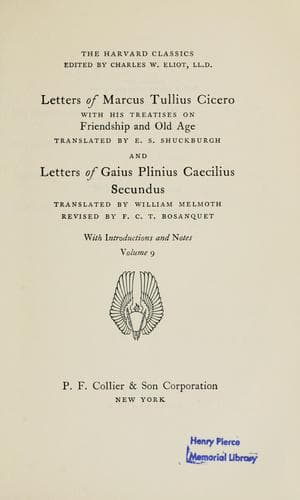
Letters of Marcus Tullius CiceroCicero, Marcus Tullius
History
Letters of Marcus Tullius Cicero
Cicero, Marcus Tullius
Authors, Latin -- Correspondence; Cicero, Marcus Tullius -- Correspondence; Statesmen -- Rome -- Correspondence
since the law had been passed by the people at the instance of
Pompey himself when consul, it should be done. The pretext for
hostilities was given. What advice or remonstrance did I omit,
when urging that any peace, even the most inequitable, should be
preferred to the most righteous war? My advice was overruled, not
so much by Pompey--for he was affected by it--as by those who,
relying on him as a military leader, thought that a victory in that
war would be highly conducive to their private interests and
personal ambitions. The war was begun without my taking any
active part in it; it was forcibly removed from Italy, while I
remained there as long as I could. But honour had greater weight
with me than fear: I had scruples about failing to support Pompey's
safety, when on a certain occasion he had not failed to support
mine. Accordingly, overpowered by a feeling of duty, or by what
the loyalists would say, or by a regard for my honor--whichever
you please--like Amphiarus in the play, I went deliberately, and
fully aware of what I was doing, "to ruin full displayed before my
eyes." In this war there was not a single disaster that I did not
foretell. Therefore, since, after the manner of augurs and
astrologers, I too, as a state augur, have by my previous predictions
established the credit of my prophetic power and knowledge of
divination in your eyes, my prediction will justly claim to be
believed. Well, then, the prophecy I now give you does not rest on
the flight of a bird nor the note of a bird of good omen on the
left--according to the system of our augural college--nor from the
normal and audible pattering of the corn of the sacred chickens. I
have other signs to note; and if they are not more infallible than
those, yet after all they are less obscure or misleading. Now omens
as to the future are observed by me in what I may call a twofold
method: the one I deduce from Caesar himself, the other from the
nature and complexion of the political situation. Caesar's
characteristics are these: a disposition naturally placable and
clement--as delineated in your brilliant book of "Grievances"--and
a great liking also for superior talent, such as your own. Besides
this, he is relenting at the expressed wishes of a large number of
your friends, which are well-grounded and inspired by affection.
not hollow and self-seeking. Under this head the unanimous
feeling of Etruria will have great influence on him.
Public-domain text, read in full here on John Shaqi.
Reviews
Reviews
No reviews yet
Be the first to share your thoughts on this work.
Elsewhere in the archive
Join the Discussion
Join the discussion
Sign in to leave a comment or review.
Sign InorCreate an account