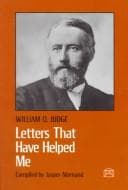
Judge, William Quan, 1851-1896; Theosophists -- United States -- Correspondence; Theosophy
"His last message to us was this 'There should be calmness. Hold fast.
Go slow.' And if you take down those words and remember them, you
will find that they contain an epitome of his whole life struggle. He
believed in Theosophy and lived it. He believed because he knew that
the great Self of which he so often spoke was the eternal Self, was
himself. Therefore he was always calm. He held fast with unwavering
tenacity to his purpose and to his ideal. He went slow, and never
allowed himself to act hastily. He made time his own, and he was
justice itself on that account. And he had the power to act with the
rapidity of lightning when the time for action came. We can now afford
to console ourselves because of the life he lived, and should also
remember that this man, William Quan Judge, had more devoted friends,
I believe, than any other living man; more friends who would literally
have died for him at a moment's notice; would have gone to any part of
the world on the strength of a hint from him. And never once did he use
that power and influence for his own personal ends;--never once did he
use that power, great as it was, not only in America, but in Europe,
Australasia and elsewhere as well, for anything but the good of the
Theosophical movement.
"Poor Judge. It was not the charges that stung him, they were too
untrue to hurt. It was the fact that those who had once most loudly
proclaimed themselves his debtors and his friends were among the
first to turn against him. He had the heart of a little child and
his tenderness was only equalled by his strength.... He never cared
what people thought of him or his work so long as they would work for
brotherhood.... His wife has said that she never knew him to tell a
lie, and those most closely connected with him theosophically agree
that he was the most truthful man they ever knew."--E. T. H.
"I knew him with some degree of intimacy for the past eight years,
meeting him often and under varied conditions, and never for one moment
did he fail to command my respect and affection, and that I should have
had the privilege of his acquaintance I hold a debt to Karma. A good
homely face and unpretentious manner, a loving disposition, full of
kindliness and honest friendship, went with such strong common sense
and knowledge of affairs that his coming was always a pleasure and his
stay a delight. The children hung about him fondly as he would sit
after dinner and draw them pictures."--A. H. SPENCER.
Public-domain text, read in full here on John Shaqi.
Reviews
Reviews
No reviews yet
Be the first to share your thoughts on this work.
Elsewhere in the archive
Join the Discussion
Join the discussion
Sign in to leave a comment or review.
Sign InorCreate an account