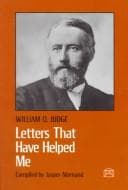
Judge, William Quan, 1851-1896; Theosophists -- United States -- Correspondence; Theosophy
Doubts and questions have arisen as to some things since the present
cloud gathered. Among others it has been said that it were better that
---- had left the chair: it would be well for him to go, and so on.
These views should not be held. If held, they should be dismissed.
There are two forces at work in the T.S., as well as in the world and
in man. These are the good and the bad. We cannot help this: it is
the Law. But we have rules, and we have preached of love and truth
and kindness; and above all, we have spoken of gratitude, not only
of Masters, but among us. Now this applies to this question of ----.
Again, he may be incompetent ... and yet be competent for the little he
has to do.... Now let me tell you: the work must not fail because here
and there personalities fall, and sin, and are unwise. TRUTH remains,
and IT IS, whoever falls: but the multitude look to the visible leader.
If he falls apart like an unjointed puzzle, at once they say, "there
is no truth there, nothing which is": and the work of a century is
ruined and must be rebuilt again from its foundations, and years of
backward tendency must come between the wreck of one undertaking and
the beginning of another. Let me say one thing I KNOW: only the feeling
of true brotherhood, of true love towards humanity aroused in the soul
of someone strong enough to stem this tide, can carry us through.
For LOVE and TRUST are the only weapons that can overcome the REAL
enemies against which the true theosophist must fight. If I, or you,
go into this battle from pride, from self-will, from desire to hold
our position in the face of the world, from anything but the purest
motives, we shall fail. Let us search ourselves well and look at it
as we never looked before: see if there is in us the reality of the
brotherhood which we preach and which we are supposed to represent.
Let us remember those famous words: "Be ye wise as serpents and harmless
as doves." Let us remember the teaching of the Sages that death in the
performance of our duty is preferable to the doing by us of the duty of
another, however well we may do the latter: the duty of another is full
of danger. Let us be of and for peace, and not for war alone.
XXI.
Public-domain text, read in full here on John Shaqi.
Reviews
Reviews
No reviews yet
Be the first to share your thoughts on this work.
Elsewhere in the archive
Join the Discussion
Join the discussion
Sign in to leave a comment or review.
Sign InorCreate an account