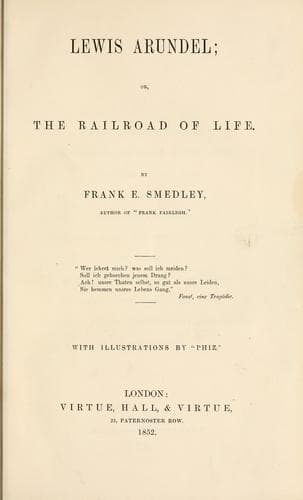
Lewis Arundel; Or, The Railroad Of LifeSmedley, Frank E. (Frank Edward)
General
Lewis Arundel; Or, The Railroad Of Life
Smedley, Frank E. (Frank Edward)
English fiction -- 19th century
Before we proceed farther, it may be as well to afford the reader an
insight into Lewis’s feelings towards this young lady, as they were by
no means of such a nature as might be expected from a young man towards
a pretty and agreeable girl, with whom he was about to be domesticated.
In order to account for his peculiar state of mind on this subject we
must take a retrospective glance at an episode in Lewis’s student life,
which has been already alluded to in a conversation between Frere and
his friend. About a year before the period at which our story opened
Lewis had encountered, at a festive meeting of the worthy citizens of
Bonn, the very pretty daughter of a wealthy shopkeeper, and struck by
her bright eyes and a certain naïve simplicity of manner, had danced
with her the greater part of the evening. Flattered by the attentions
of the handsome young Englishman, the damsel, who (her simplicity being
confined entirely to manner) was as arrant a little flirt as ever caused
a heartache, took care that the acquaintance should continue; and while
she was merely bent on adding to her train of admirers, Lewis fell
in love with her as deeply as a man can do with a girl completely his
inferior in mind as well as in station. Imagination, however, which
at eighteen is alarmingly active, supplied all deficiencies, and Lewis
continued to dream his lady-love was an angel, till one fine morning
the fact of her elopement with a young German baron, who looked upon
matrimony as a superfluous ordinance, induced him to alter his opinion.
With the termination of the adventure the reader is already acquainted,
but the effect upon Lewis’s disposition was one which time might weaken
but could never efface. The fatal lesson that one who seemed true and
pure was not so, once learnt could never be forgotten; the seeds of
mistrust were sown, and strive as he might, the perfect faith, the
bright, eager confidence of youth, were lost to him for ever.
Public-domain text, read in full here on John Shaqi.
Reviews
Reviews
No reviews yet
Be the first to share your thoughts on this work.
Elsewhere in the archive
Join the Discussion
Join the discussion
Sign in to leave a comment or review.
Sign InorCreate an account