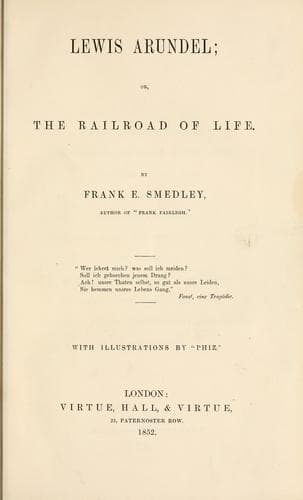
Lewis Arundel; Or, The Railroad Of LifeSmedley, Frank E. (Frank Edward)
General
Lewis Arundel; Or, The Railroad Of Life
Smedley, Frank E. (Frank Edward)
English fiction -- 19th century
Miss Livingstone had, by Lewis’s advice, ordered post-horses to the
carriage, and was in that way enabled to accomplish her round of visits.
Lewis carried out his intention of driving the iron-greys, who conducted
themselves with so much propriety that on the following day he took his
pupil with him, and finding the drive pleased and amused the poor boy he
repeated it every fine day. Thus a week slipped away, and the time for
the General’s return arrived. It was late on the afternoon of the day
on which he was expected, and Lewis was wearily assisting poor Walter to
spell through a page of dissyllables, when that peculiar gravel-grinding
sound became audible which, in a country house, necessarily precedes
an arrival. Then there was a great bustle as of excited servants, a
Babel-like confusion of tongues, bumps and thumps of heavy luggage,
much trampling of feet, ringing of bells and slamming of doors; then
the sounds grew fainter, were remitted at intervals, and at last ceased
altogether. The house was no longer masterless--General Grant had
returned. Walter’s attention, by no means easy to command for five
minutes together at the best of times, became so entirely estranged by
the commotion above alluded to, that Lewis closed the book in despair
and told him to go and play with Faust, who, sitting upright on a rug in
front of the fire, was listening with the deepest interest to all that
passed in the hall, and was only restrained from barking by a strict
sense of propriety operating on a well-disciplined mind. The boy gladly
obeyed, and Lewis, resting his aching head on his hand, fell into deep
thought--he thought of old times, when, head of his class at a public
school, alike leader and idol of the little world in which he moved, his
young ambition had shaped out for itself a career in which the bar, the
bench, the senate, were to be but stepping-stones to the highest honours
to which energy and talent might attain; and he contrasted his present
position with the ideal future his boyish fancy had depicted. Then he
bethought him of the tyrant who commanded that a living man should be
chained to a corpse, and considered how the cold and numbing influence
of the dead, gradually paralysing the vital energy of the living, was,
as it were, typical of his own fate. He could not but be conscious
of unusual powers of mind, for he had tested them in the struggle for
honours with the deep and subtile thinkers of Germany, and had come off
victorious; and to reflect that these talents, which might have ensured
him success in the game of life, were condemned to be wasted in the
wearying attempt to call forth the faint germs of reason in the mind
of an almost childish idiot! The thought was a bitter one! and yet for
months past he had felt resigned to his fate; and the deep interest he
took in his pupil’s improvement, together with the time such a quiet
life afforded for reflection and self-knowledge, had rendered him
Public-domain text, read in full here on John Shaqi.
Reviews
Reviews
No reviews yet
Be the first to share your thoughts on this work.
Elsewhere in the archive
Join the Discussion
Join the discussion
Sign in to leave a comment or review.
Sign InorCreate an account