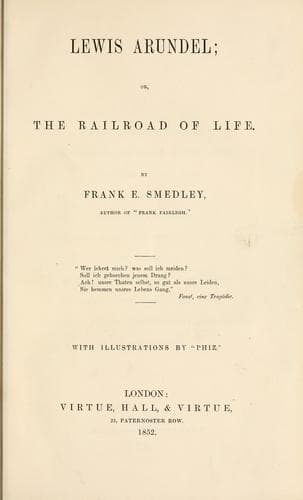
Lewis Arundel; Or, The Railroad Of LifeSmedley, Frank E. (Frank Edward)
General
Lewis Arundel; Or, The Railroad Of Life
Smedley, Frank E. (Frank Edward)
English fiction -- 19th century
“Yes you can,” interposed Lewis, “when I have cleared the road for
you, and shown you how to do it. Sit still and watch me.” So saying,
he selected a place where the hedge was thin and the ditch and bank
practicable, and putting his horse into an easy canter, rode at it.
Being particularly anxious that nothing should go wrong, and that Walter
should be convinced of the feasibility of the attempt, Lewis was not
best pleased when his horse, instead of rising to the leap, refused it,
and replied to a tolerably sharp application of the spur by plunging
violently and turning short round. His rider, however, sat as firmly
as if he were part of the animal, and cantering round two sides of the
field, got him well in hand and again rode him at the hedge, working his
mouth with the bit and giving him the spur. This discipline produced the
desired effect; for instead of refusing the leap this time, the horse
sprang forward with a bound which would have cleared an obstacle of
twice the size, and alighted on the other side several feet beyond the
ditch. Lewis rode on a few yards, and then turning, leaped back into the
field and rejoined his pupil. “Now, Walter, you must do as I have done.
Canter up to that gap, give the pony his head, touch him on the flank as
he approaches the hedge, sit firmly and press in your knees, and you’ll
go over as nicely as possible.”
But poor Walter’s courage failed him; the conflict between Lewis and
his horse had destroyed his confidence, and he was afraid to make the
attempt. His tutor read it in his blanched cheek and quailing glance,
and being as kind and judicious as he was firm, forbore to press the
point, and dismounting, led the pony through the gap, and assisted
Walter to scramble over on foot; then remounting his steed, he tested
his obedience by once more leaping him over; and having thus achieved
the adventure of the locked gate, tutor and pupil cantered off across
the common. But this little episode had caused some loss of time, and
when Lewis reached the lane leading to the village, near which Colonel
Norton’s house was situated, he learned from a man who was mending
the road that a phaeton, answering the description of General Grant’s
equipage, had passed a few minutes before.
“My friend Richards’ fears were needlessly excited then, it seems, and
the old gentleman is a better whip than he gave him credit for being,”
thought Lewis. “Come, Walter,” he added aloud, “we will go back by the
road. Don’t trot just yet; the horses are warm, we must allow them to
get a little cool.”
Public-domain text, read in full here on John Shaqi.
Reviews
Reviews
No reviews yet
Be the first to share your thoughts on this work.
Elsewhere in the archive
Join the Discussion
Join the discussion
Sign in to leave a comment or review.
Sign InorCreate an account