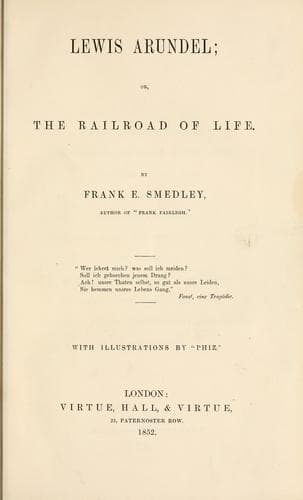
Lewis Arundel; Or, The Railroad Of LifeSmedley, Frank E. (Frank Edward)
General
Lewis Arundel; Or, The Railroad Of Life
Smedley, Frank E. (Frank Edward)
English fiction -- 19th century
“I know not how to thank you for such unexampled kindness; you are
indeed returning good for evil,” replied Lewis warmly. He paused for a
moment, as if he were considering how best he might express his meaning,
then added, “As far as may be, I shall most gladly avail myself of the
privilege of your friendship. I cannot tell you the weight you have
taken off my mind by this convincing proof of your forgiveness. You may
imagine how exquisitely painful, knowing how little I deserved them,
were all the civil speeches people considered it necessary to make me
on my ‘gallant conduct,’ as they termed it; as if there were anything
wonderful in swimming a few yards to save a life!--the wonder would be
for any man who could swim _not_ to do so.”
“And yet, thinking thus lightly of the peril, you tell me you were so
carried away by your angry feeling as to hesitate whether or not to
leave me to perish,” returned Annie reflectively. “How strange that
the mind can be engrossed by passion so completely as to banish all its
natural impulses!”
“You will laugh at me, and think my German education has filled my brain
with strange, wild fancies,” replied Lewis; “but I believe that we
are under a species of demoniacal possession at such moments--that by
indulging our evil feelings instead of resisting them we have given
Satan additional power over us. You know the legend of the Wild
Huntsman: I cannot but look upon the description of the spirit-riders
who accompanied the baron, one on a white, the other on a black steed,
and alternately plied him with good and evil counsel, less as an
allegory than a reality.”
“You believe, then, that we are constantly surrounded by spiritual
beings imperceptible to our bodily senses?” asked Annie. “It is rather a
fearful idea.”
“Believe,” returned Lewis, “is perhaps too strong a term to apply to
any theory not distinctly borne out by Holy Writ, but as far as I
have studied the subject, I think the existence of spiritual beings
of opposite natures, some good, some evil, is clearly indicated by
Scripture; and there are many passages which would lead one to suppose
that they are permitted, under certain restrictions, to interest
themselves in mundane affairs, and influence the thoughts which are the
springs of human actions--immaterial agents, in fact, for working out
the will of God. Nor do I see anything fearful in the idea; on the
contrary, as we cannot doubt that it is our own fault if the evil
spirits ever prevail against us, and that good angels witness our
struggles to do right, and are at hand to assist us, I consider the
theory a most consolatory one.”
Public-domain text, read in full here on John Shaqi.
Reviews
Reviews
No reviews yet
Be the first to share your thoughts on this work.
Elsewhere in the archive
Join the Discussion
Join the discussion
Sign in to leave a comment or review.
Sign InorCreate an account