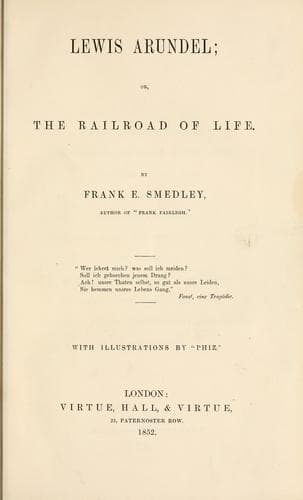
Lewis Arundel; Or, The Railroad Of LifeSmedley, Frank E. (Frank Edward)
General
Lewis Arundel; Or, The Railroad Of Life
Smedley, Frank E. (Frank Edward)
English fiction -- 19th century
in question was a very young one, little more than a boy in fact (if
a duke can ever be considered in the light of a boy). This youthful
nobleman had a leading idea--though you would hardly have supposed it,
to look at him--he believed that he was the best match in England; and
so, in the conventional sense of the term, he undoubtedly was, although
he would have been very dear at the price to any woman with a head and
a heart. His pastors and masters, backed by the maternal anxieties of
a duchess unambitious of the dignities of dowagership, had sedulously
cultivated this one idea till it had assumed the character of
a monomania, under the influence of which this unhappy scion of
aristocracy looked upon life as a state of perpetual warfare against the
whole race of women, and was haunted by a frightful vision of himself
carried off and forcibly married to the chief of a horde of female
pirates, with long tongues, longer nails, and an utter absence of
creditable ancestry. His outward duke (if we may be allowed the
expression) was decidedly prepossessing. He was tall and not ungraceful
in figure, and had a bright, round, innocent face, as of a good child.
His hair was nicely brushed and parted; whiskers he had none; indeed,
the stinginess of nature to him in this particular was so remarkable,
that, as the eldest Miss Simpkins afterwards observed to an eager
audience of uninvited younger sisters, “So far from whiskers, my dears,
now I come to think of it, his Grace had _rather the reverse!_” However,
take him “for all in all,” he was a very creditable young duke, and a
perfect godsend on the occasion in question. Then there was a descending
scale from his Grace downwards, leading through the aristocracy of birth
to the aristocracy of riches, till it reached the _élite_ of the country
towns, and the more presentable specimens of yeomen farmers. But let
us join a group of people that we know, and hear what they think of the
guests who are so rapidly assembling.
Public-domain text, read in full here on John Shaqi.
Reviews
Reviews
No reviews yet
Be the first to share your thoughts on this work.
Elsewhere in the archive
Join the Discussion
Join the discussion
Sign in to leave a comment or review.
Sign InorCreate an account