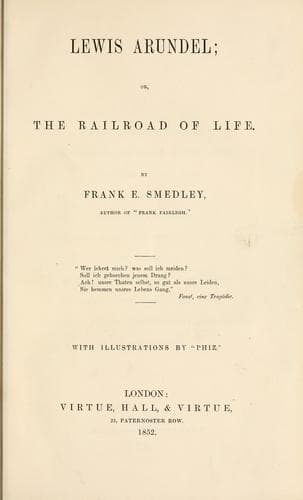
Lewis Arundel; Or, The Railroad Of LifeSmedley, Frank E. (Frank Edward)
General
Lewis Arundel; Or, The Railroad Of Life
Smedley, Frank E. (Frank Edward)
English fiction -- 19th century
As he spoke the lady in question joined the group. Her age might be
eight or nine-and-thirty; she was tall and decidedly handsome, though
her features were too large; she had magnificent black eyes and very
white teeth, which prevented the width of her mouth from interfering
with her pretensions to beauty; her complexion was brilliant in the
extreme, nature having bestowed on her a clear brown skin, which
withstood the combined effects of exposure to sun and wind, and softened
the high colour induced by the boisterous character of her ladyship’s
favourite pursuits. But if her personal gifts were striking, the style
or costume she saw fit to adopt rendered her still more remarkable. As
it will be necessary to describe her dress minutely in order to convey
any idea of her appearance, we throw ourselves on the mercy of our lady
readers, and beg them to pardon all errors of description, seeing that
mantua-making is a science in which we have never graduated, and of
which our knowledge is derived solely from oral traditions picked up
during desultory conversations among our female friends, usually held
(if our memory fail us not) on their way home from church.
Her dress consisted, then, of a gown of exceedingly rich white silk,
made half-high in the body and remarkably full in the skirt, over which
she wore a polka of bright scarlet Cashmere lined and trimmed with white
silk, and adorned with a double row of the hunt buttons. Her head was
attired in a Spanish hat of black velvet, while a single white feather,
secured by a valuable diamond clasp, was allowed to droop over the
brim and mingle with the rich masses of her raven hair, which was
picturesquely arranged in a complication of braids and ringlets. She
leaned on the arm of a gentleman double her age, whose good-humoured
heavy face afforded a marked contrast to the ever-varying expression
that lit the animated features of her who was, in every sense of the
word, his better half. Leicester’s description had but slightly enhanced
the vigour of her mode of salutation, for as she reached the spot where
he stood she clapped him on the shoulder with a small, white-gloved
hand, exclaiming in a deep but not unmusical voice--
“Bravo, Charley! run you to earth at last, you see. Where have you
hidden yourself all this age? Now, Goody,” she continued, turning to her
husband, “you may go. Charley Leicester will take care of me--don’t lose
your temper at whist, don’t drink too much champagne, and mind you’re
forthcoming when I want you.”
“There’s a life to lead,” returned her spouse, appealing to Leicester.
“Did you ever see such a tyrant?”
“Be off, Goody, and don’t talk nonsense,” was his lady-wife’s rejoinder.
[Illustration: 0178]
“How is it we never see you at the Manor-House now?” began the master of
that establishment in a hospitable tone of voice, but his lady cut him
short in his speech by exclaiming--
Public-domain text, read in full here on John Shaqi.
Reviews
Reviews
No reviews yet
Be the first to share your thoughts on this work.
Elsewhere in the archive
Join the Discussion
Join the discussion
Sign in to leave a comment or review.
Sign InorCreate an account