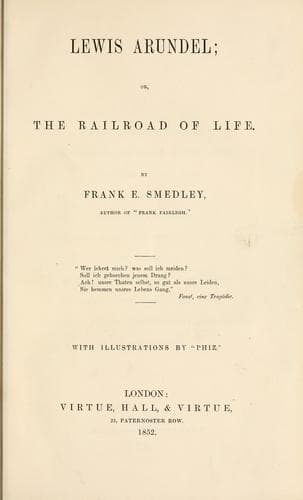
Lewis Arundel; Or, The Railroad Of LifeSmedley, Frank E. (Frank Edward)
General
Lewis Arundel; Or, The Railroad Of Life
Smedley, Frank E. (Frank Edward)
English fiction -- 19th century
appeared singularly unwilling to face death at that particular epoch,
and contrived accordingly by some means or other to render themselves
invisible. In vain did Millar try the choicest spinnies, in vain did
he scramble through impassable hedges, where gaps there were none,
rendering himself a very pin-cushion for thorns; in vain did he creep
along what he was pleased to term dry ditches, till from the
waist downwards he looked more like a geological specimen than a
leather-gaitered and corduroyed Christian; still the obdurate pheasants
refused to stand fire, either present or prospective (gun or kitchen),
and at the end of three hours’ hard walking through the best preserves
the disconsolate gamekeeper had only succeeded in bagging a brace.
At length completely disheartened, he came to anchor on a stile,
and produced a flask of spirits, with the contents of which (after
fruitlessly pressing Lewis and Walter to partake thereof) he proceeded
to regale himself. Finding himself the better for this prescription,
he shouted to a dishevelled individual yclept the beater, who for the
trifling consideration of eighteenpence per diem and a meal of broken
victuals, delivered himself over to the agreeable certainty of being wet
_to_ the skin, and scratched and torn _through_ it, with the by no means
remote contingency of getting accidentally shot into the bargain. The
creature who appeared in answer to this summons, and who in spite of
the uncomfortable description we have given of his occupation, seemed to
enjoy his day’s sport excessively, was too old for a boy and too young
for a man. His face was, of course, scratched and bleeding, and his
elf locks, drenched with the hoar frost, now melted into a species of
half-frozen gelatine, gave him a strange, unearthly appearance. His
clothing, if rags which looked like the cast-off garments of an indigent
scarecrow deserved the name, was so tattered and torn, that the fact of
their hanging upon him at all was calculated to shake one’s faith in the
Newtonian theory of gravitation, till one gained a clue to the mystery
by recollecting the antagonistic principle “attraction of cohesion;”
the only personal attraction, by the way (save a pair of clear grey eyes
giving a shrewd expression to his face), that our friend possessed.
Public-domain text, read in full here on John Shaqi.
Reviews
Reviews
No reviews yet
Be the first to share your thoughts on this work.
Elsewhere in the archive
Join the Discussion
Join the discussion
Sign in to leave a comment or review.
Sign InorCreate an account