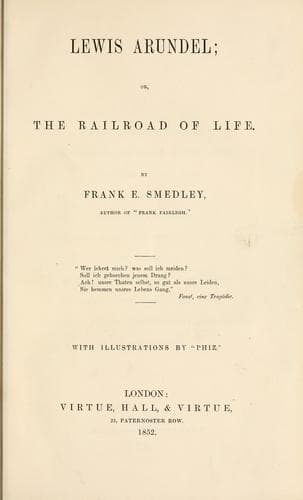
Lewis Arundel; Or, The Railroad Of LifeSmedley, Frank E. (Frank Edward)
General
Lewis Arundel; Or, The Railroad Of Life
Smedley, Frank E. (Frank Edward)
English fiction -- 19th century
“I sees!” rejoined the keeper reflectively. “Yer didn’t happen
haccidentally to know any o’ they three coves, Villiam, I suppose?”
“Ther von has carried the sack worn’t haltogither unlike long Hardy, the
blacksmith,” was the reply.
The worthy Mr. Millar meditated for some minutes in silence on the
information thus acquired; then rousing himself with a sudden start, he
observed, “Now, Villiam, hif you’ll be so hobliging has to beat along
that ere ’edgerow to the right, ve’ll see hif ve can knock hover
another brace o’ longtails, and ve can talk about Mr. Hardy ven ve have
finished our day’s vork. There’s a precious young limb o’ vickedness,”
he added, turning to Lewis as the boy got out of earshot, “he’s von hof
’em, bless yer, only he’s turned again ’em with a mercenary view hof
getting a hunder-keeper’s sitivation.”
“In which rascality do you mean to allow him to succeed?” asked Lewis.
“Not by no manner o’ means--halways supposing I can pump him dry
without,” was the prudent reply; and shouldering his doublebarrel the
gamekeeper quitted his perch on the stile and resumed his shooting.
Whether the intelligence he had received had affected his nervous system
(reserving for future discussion the more doubtful question of his
possessing such an aristocratic organisation), or whether in the
excitement of the moment he had allowed himself to imbibe an unusually
liberal allowance of the contents of the spirit-flask, we do not pretend
to decide; but certain it is that he missed consecutively two as fair
shots as ever presented themselves to the gun of a sportsman, and ended
by wounding, without bringing down, a young hen pheasant, despite the
warning cry of “‘ware hen” from the perfidious “Villiam,” then located
in a quagmire.
“Veil, I never did!” exclaimed the unfortunate perpetrator of this the
greatest crime which in a gamekeeper’s opinion a sportsman can commit;
“I ’aven’t done sich a think has that since I wos a boy o’ thirteen
year old, and father quilted me with the dog-whip for it, and sarve
me right, too. This here’s a werry snipey bit, too,” he continued
dejectedly; “but hif I can’t ’it apheasand, hit’s useless to ’old up
my gun hat a snipe.”
“Your ill luck in the morning has made you impatient and spoiled your
shooting,” observed Lewis, wishing good-naturedly to propitiate his
companion.
This speech, however, seemed to produce just a contrary effect, for
Millar answered gruffly, “Perhaps, Mister, you fancies as you can do
better yourself; hif so, you’re velcome to take the gun and try.”
“I’ve no objection,” replied Lewis, smiling at the very evident contempt
in which, as a “Lunnuner,” his companion held him; “I’ll try a shot or
two, if you like.”
“Here you are, then, sir,” was the reply, as the keeper handed him the
gun; “the right barrel’s shotted for pheasands, and the left for snipes;
so look hout, and if yer don’t bag Villiam, or Master Valter here,
hit’ll be a mercy, I expects.”
Public-domain text, read in full here on John Shaqi.
Reviews
Reviews
No reviews yet
Be the first to share your thoughts on this work.
Elsewhere in the archive
Join the Discussion
Join the discussion
Sign in to leave a comment or review.
Sign InorCreate an account