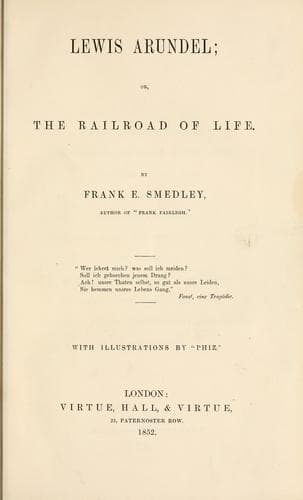
Lewis Arundel; Or, The Railroad Of LifeSmedley, Frank E. (Frank Edward)
General
Lewis Arundel; Or, The Railroad Of Life
Smedley, Frank E. (Frank Edward)
English fiction -- 19th century
As he spoke--throwing off for a moment the cold reserve which had now
become habitual to him--his eyes flashed, he drew himself up to his full
height, and flung back his graceful head with an air of proud defiance.
The gamekeeper regarded him fixedly, and mentally compared him with,
not the fighting gladiator, for Millar’s unclassical education had never
rendered him acquainted with that illustrious statue, but he had
once been present at a prize-fight, in which a tall, athletic youth,
rejoicing in the ornithological sobriquet of “the spicy Dabchick,”
proved victor, and to that dabchick did he assimilate Lewis. At length
his thoughts found vent in the following ejaculation--
“Veil, Mr. Arundel, hif ther’s many more like you hup there, that
blessed Lunnun can’t be as bad a place as I thought it.”
Lewis smiled. Perhaps (for, after all, he was human and under
twenty-one) the evident admiration which had replaced the no less
evident contempt with which the sturdy gamekeeper had regarded him
earlier in their acquaintance was not without its charm; at all events,
when, after another hour’s shooting, Millar went home to dinner, and
Lewis and Walter returned to Broadhurst, the young tutor diminished his
income to the extent of half-a-crown, and the keeper, as he pocketed
the “tip,” renewed his assurance that he would send Mr. Arundel timely
notice “vhenever there vas a chance of being down upon that poarching
willain, Hardy.”
Charley Leicester, as he did not start for Constantinople, found himself
at liberty to escort Laura Peyton and his cousin Annie to view the ruins
of Monkton Priory, which in themselves were quite worth the trouble of
a ride; had they, however, been even a less interesting combination
of bricks and mortar than the National Gallery in Trafalgar Square
(supposing such a thing possible), it would not have signified to the
party who then visited them. Never were three individuals less inclined
to be critical, or more thoroughly determined to be pleased with
everything. The old grey ruins, frowning beneath the clear wintry sky,
appeared the colour of strawberry ice to them; every object reflected
the rose-tint of their happiness. As for Charley, a change had come o’er
him. The indolent, fastidious man of fashion, whose spotless gloves and
irreproachable boots were the envy and admiration of Bond Street, had
disappeared, and in his place arose an honest, genuine, light-hearted,
agreeable, sensible being, to whom nothing seemed to come amiss, and
who appeared endowed with a preternatural power of diffusing his own
superabundant happiness amongst all who came in contact with him. The
girth of his saddle broke; they had no groom with them. “Grooms were
such a bore, he would be groom,” Charley had said; consequently there
were no means at hand by which the injury could be repaired.
“Well, never mind; he would get some string at the first cottage and tie
it up; he was rather glad it had happened, riding without a girth was
great fun.”
Public-domain text, read in full here on John Shaqi.
Reviews
Reviews
No reviews yet
Be the first to share your thoughts on this work.
Elsewhere in the archive
Join the Discussion
Join the discussion
Sign in to leave a comment or review.
Sign InorCreate an account