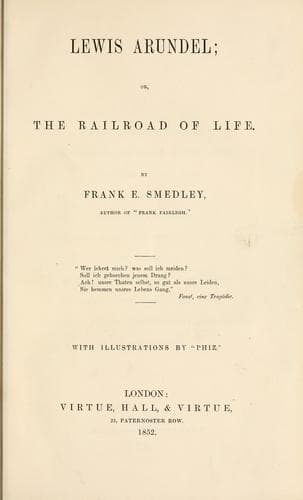
Lewis Arundel; Or, The Railroad Of LifeSmedley, Frank E. (Frank Edward)
General
Lewis Arundel; Or, The Railroad Of Life
Smedley, Frank E. (Frank Edward)
English fiction -- 19th century
Lewis smiled and attempted to reply, but the words died away upon his
lips, and completely overcome by faintness, he would have fallen from
the chair had not Leicester supported him. Fortunately, at this moment
the surgeon arrived, and Annie quitting the apartment, Lewis’s sleeve
was cut open, his wound temporarily bound up, and his temples bathed
with some stimulating essence which dispelled his faintness, before the
surgeon’s services were required for General Grant. The latter gentleman
had recovered consciousness ere he reached Broadhurst, and though
suffering acute pain from his broken arm, appeared cool and collected.
His first question had been “whether Hardy had escaped,” and he seemed
to revive from the moment he was informed of his capture. His next
inquiry was who had taken him, and on learning it was Lewis, he was much
pleased, muttering, “Brave lad, brave lad! pity he’s not in the army.”
He recognised Annie and spoke kindly to her, gave orders for the safe
custody of Hardy, demanded of the surgeon who examined his arm whether
he wished to amputate it, as he felt quite equal to the operation, and
in short, under circumstances which would have overpowered any man of
less firmness of character, behaved like a gentleman and a brave old
soldier, as he was. Fortunately the surgeons (for a second, attracted
by the rumour of an accident, as vultures are if a camel dies in the
desert, had come to test the truth of the old proverb that two heads
are better than one) succeeded in setting the arm, pronounced amputation
unnecessary, and after careful examination, gave it as their opinion
that, with the exception of a few contusions of little consequence,
the General had sustained no further injury. Having come to this
satisfactory conclusion, they found time to direct their attention to
Lewis. After much whispered consultation and considerable exchange of
learned winks and profound nods, they informed him that he had been
wounded by a shot from a pistol (which, by the way, he could have told
them), and that they had very little doubt that the ball remained in the
wound, in which case it would be necessary to extract it. To this Lewis
replied, “The sooner the better.” Accordingly they proceeded to put him
to great agony by probing the wound to find the ball, after which they
hurt him still more in extracting it, performing both operations with
such easy cheerfulness of manner and utter disregard of the patient’s
feelings, that a bystander would have imagined they were carving a cold
shoulder of mutton rather than the same joint of live humanity. But
surgeons, like fathers, have flinty hearts, unmacadamised by the
smallest grain of pity for the wretched victims of their uncomfortable
skill; their idea of the “Whole Duty of Man” being that he should afford
them “an interesting case” when living, and become a “good subject”
for them when he has ceased to be one to the Queen. After the ball was
Public-domain text, read in full here on John Shaqi.
Reviews
Reviews
No reviews yet
Be the first to share your thoughts on this work.
Elsewhere in the archive
Join the Discussion
Join the discussion
Sign in to leave a comment or review.
Sign InorCreate an account