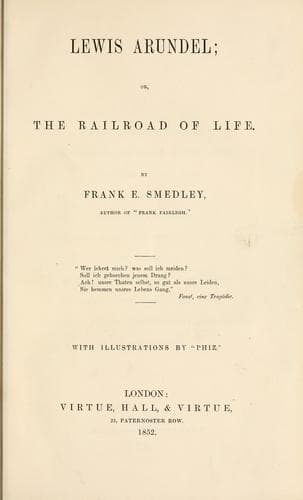
Lewis Arundel; Or, The Railroad Of LifeSmedley, Frank E. (Frank Edward)
General
Lewis Arundel; Or, The Railroad Of Life
Smedley, Frank E. (Frank Edward)
English fiction -- 19th century
The happy pair had determined to test the endurance of their felicity by
starting for the Rhine, which popular river it was their intention to
go up as far as it was go-up-able, then proceed to Switzerland, do that
land of musical cows and icy mountains thoroughly, and finally take up
their quarters at Florence, where Leicester had succeeded in obtaining
a diplomatic appointment. A letter had been received from them dated
Coblentz, wherein it appeared their newfound happiness had stood the
voyage better than might have been expected; a fact mainly attributable
to their having had an unusually calm passage. Laura considered the
Rhine scenery exquisite; Charley thought it all very well for a change;
but for a constancy, he must confess he preferred the Serpentine. He
was disgusted with the German students, whom he stigmatised as “awful
tigers,” wondered why the women wore short petticoats if they hadn’t
better ankles to show, complained bitterly of the intense stupidity of
the natives for not understanding either French or English, and wound
up by a long, violent sentence quite unconnected with all that had gone
before it, setting forth his unalterable conviction that Laura was an
angel, which unscriptural assertion he reiterated four times in as many
lines.
A change had taken place in Rose Arundel, and Lewis, as he gazed with
affection on her calm, pensive brow, and marked the earnest, thoughtful
expression of her soft, grey eyes, felt that she was indeed altered: he
had left her little more than a child, he found her a woman in the best
and fullest sense of the expression. Reader, do you know all that phrase
implies? do you understand what is meant by a woman in the true and
fullest sense of the term?
“Eh? I should rather think I did, too, just a _very_ little,” replies
Ensign Downylip, winking at society at large; “know what a woman is?
yes, I consider that good, rather.”
“And what, oh! most exquisite juvenile, may be your definition of woman
as she should be?”
The Ensign strokes his upper lip where that confounded moustache is so
very “lang a comin’,” rubs his nose to arouse his intellect, which
he fails to do because that faculty is not asleep but wanting, and
replies--
“Ar--well, to begin with: woman is of course a decidedly inferiar
animal, but--ar--take the best specimen of the class, and you’ll find it
vewy pwitty, picquante, devoted to polking, light in hand, clean about
the pasterns, something like Fanny Elsler, with a dash of Lady--to
give it style (I can’t stand vulgawity), decidedly fast (I hate your
cart-horsey gals)! plenty of bustle to make it look spicy, ready to
go the pace no end, and able properly to--ahem! appweciate ‘Yours
truly’--ar--that’s about the time of day, eh, Mr. Author!”
Public-domain text, read in full here on John Shaqi.
Reviews
Reviews
No reviews yet
Be the first to share your thoughts on this work.
Elsewhere in the archive
Join the Discussion
Join the discussion
Sign in to leave a comment or review.
Sign InorCreate an account