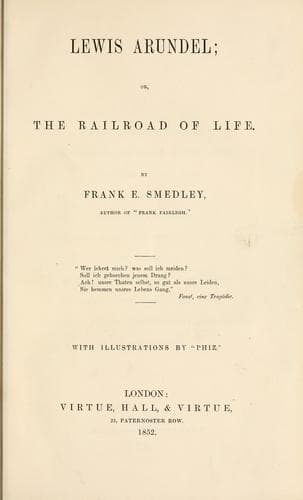
Lewis Arundel; Or, The Railroad Of LifeSmedley, Frank E. (Frank Edward)
General
Lewis Arundel; Or, The Railroad Of Life
Smedley, Frank E. (Frank Edward)
English fiction -- 19th century
Less than five minutes, however, served
to set the matter at rest. The sixth button was left high and dry, the
fifth reappeared, and was succeeded by another and another; certain
landmarks, whose immersion I had watched with anxious eyes, again became
visible, and I was thinking of making a final effort to reach _terra
firma_ before the increasing darkness should throw new difficulties in
the way, when my ears were greeted by a distant ‘Halloo.’ I shouted in
reply, and soon had the satisfaction of perceiving a flat-bottomed
boat making towards me, propelled by my host and the old man who I had
conceived basely to have deserted me. As they drew me, half-crippled
with cold and exhaustion, into the boat, Fenwick began haranguing me in
a composite strain of upbraiding and condolence, but I cut him short by
raising my head as I lay sousing in a puddle at the bottom of the punt,
and murmuring in a faint voice--‘Never mind, old fellow, it’s all right,
for _I’ve got the Podiceps Cornutus_.’ And touching that same bird, here
we are at the stuffer’s shop; so come along in, and I’ll show him to you
bodily.”
A week had elapsed since the morning on which the above conversation
took place, a week in which many events had occurred. The mighty
Nonpareil, still considering the _via media_ a promising investment, had
condescended graciously to purchase Rose’s manuscript, and when Frere,
who brought her the intelligence, placed in her hands a cheque for
£100, which, relying on her profound ignorance of business forms, he had
kindly substituted for the publisher’s bill at six months, she received
it with a start of delight. The girl was so happy! she had at length
realised her darling project; she had, by her own exertions, helped to
lighten Lewis’s burden; she had done something towards shortening his
period of banishment, for such she considered his enforced residence at
Broadhurst. Poor Rose! she had not a particle of avarice in her whole
nature, and yet never did miser rejoice over his hoards as she did
over that hundred pounds; for it was by no means to be spent--that,
fortunately, was unnecessary, as Mrs. Arundel, albeit wanting mental
ballast in some points, was a notable housewife, and as for Rachel, she
was a very dragon in her care of that Hesperides, the larder; so that
out of the liberal allowance Lewis made to them, his mother and sister
were privately saving a small fund, destined, as they fondly hoped,
to advance at some future time his fortunes; and to this store Rose’s
hundred pounds would make a magnificent addition. And the joy it was
to her thus to dedicate it! Could she have purchased with it the most
desirable match in England, the hand of that identical young duke who
was exhibited to correct radical tendencies at the electioneering ball
at Broadhurst, his Grace might have died a bachelor ere Rose would have
diverted the money from its appointed purpose. But something ought to be
done with it.
Public-domain text, read in full here on John Shaqi.
Reviews
Reviews
No reviews yet
Be the first to share your thoughts on this work.
Elsewhere in the archive
Join the Discussion
Join the discussion
Sign in to leave a comment or review.
Sign InorCreate an account