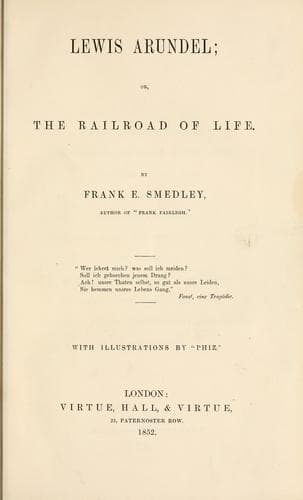
Lewis Arundel; Or, The Railroad Of LifeSmedley, Frank E. (Frank Edward)
General
Lewis Arundel; Or, The Railroad Of Life
Smedley, Frank E. (Frank Edward)
English fiction -- 19th century
Dear Rose Arundel (excuse us the adjective, kind reader, for we
frankly own to being very fond of her), having been a perfect godsend to
everybody during the whole morning of the party day, having thought
of everything and done everything, and looked on the bright side of
everything, and sacrificed herself so pleasantly that an uninitiated
beholder might have imagined her intensely selfish and doing it all for
her own personal gratification,--Rose having, amongst other gymnastics
of self-devotion, run up and down stairs forty-three times in pursuit of
waifs and strays from Lady Lombard’s memory, committed the first bit
of selfishness of which she had been guilty all day, by sitting down
to rest for five minutes before she began her toilet; and leaning
her forehead on her hand, thought over her own chances of pleasure or
amusement during the evening. She had had one disappointment: Lewis
had been invited, and Lewis would not come. He did not say he could not
come, but he put on what Mrs. Arundel called his “iron-face,” and said
shortly, “the thing was impossible;” and no one could have looked on his
compressed lips and doubted the truth of the assertion. It grieved Rose,
for she read his soul as it were an open book before her, and she saw
there pride, that curse of noble minds, still unsubdued. Lady Lombard
patronised them, and Lewis could not submit to witness it. Rose had
hoped better things than this; she had not failed to observe the change
that had taken place in her brother during his residence at
Broadhurst; she saw that from an ardent, impetuous boy he had become an
earnest-minded, high-souled man, and in the calm dignity of his look and
bearing she recognised the evidence of conscious power, chastened by the
discipline of a mind great enough to rule itself. Nor was she wrong in
her conjectures; only she mistook a part for the whole, and arguing with
the gentle sophistry of a woman’s loving heart, concluded that to be
finished which was but in fact begun. Lewis had learned to _control_
(except in rare instances) his haughty nature, but he relied too much on
his own strength, and so he had failed as yet to subdue it. Rose was
too honest to disguise the truth from herself when it was fairly placed
before her, and she acknowledged, with an aching heart that the great
fault of her brother’s character yet remained unconquered. Poor Rose! as
this conviction forced itself upon her, how she sorrowed over it. He
was so good, so noble, and she loved him so entirely--oh! why was he not
perfect? If Lewis could have read her thoughts at that moment he would
have assuredly made one of the guests at Lady Lombard’s hospitable
board.
Public-domain text, read in full here on John Shaqi.
Lewis Arundel; Or, The Railroad Of Life — John Shaqi
Reviews
Reviews
No reviews yet
Be the first to share your thoughts on this work.
Elsewhere in the archive
Join the Discussion
Join the discussion
Sign in to leave a comment or review.
Sign InorCreate an account