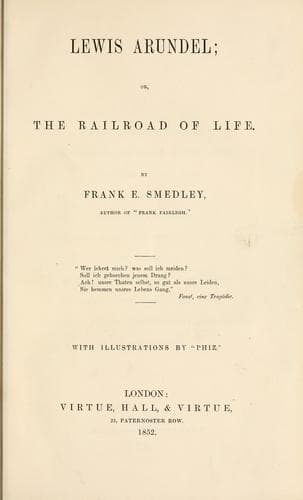
Lewis Arundel; Or, The Railroad Of LifeSmedley, Frank E. (Frank Edward)
General
Lewis Arundel; Or, The Railroad Of Life
Smedley, Frank E. (Frank Edward)
English fiction -- 19th century
“May I inquire how you propose to prevent the impending catastrophe?”
asked superciliously the moustached gentleman to whom we have before
alluded.
“You shall see directly,” returned Lewis, divesting himself of his coat,
waistcoat, and neckcloth.
“I presume you are aware there is not one man in a hundred who could
swim that distance in his clothes,” resumed the speaker in the
same sneering tone. “Do you actually--I merely ask as a matter of
curiosity--do you really consider it worth while to peril your life for
that of a dog?”
“For such a noble dog as that, yes!” replied Lewis sternly. “I might
not take the trouble for a _mere puppy_;” and he pronounced the last two
words with a marked emphasis, which rendered his meaning unmistakable.
The person he addressed coloured with anger and slightly raised his
cane, but he read that in Lewis’s face which caused him to relinquish
his intention, and smiling scornfully he folded his arms and remained to
observe the event.
This was Lewis’s introduction to Charles Leicester’s elder brother, Lord
Bellefield, the affianced of Annie Grant.
Having completed his preparations, Lewis placed the knife between his
teeth, and motioning to the crowd to stand on one side, gave a short
run, dashed through the shallow water, and then, breasting the stream
gallantly, swain with powerful strokes towards the still struggling
animal. As he perceived his master approaching, the poor dog ceased
howling, and seemingly re-animated by the prospect of assistance,
redoubled his efforts to keep himself afloat.
In order to avoid the stroke of his paws, Lewis swam round him, and
supporting himself by resting one hand upon the buoy, he grasped the
knife with the other, and at one stroke severed the string. The effect
was instantly perceptible: freed from the restraint which had till now
paralysed his efforts, the dog at once rose higher in the water; and
even in that extremity his affection for his master overpowering his
instinct of self-preservation, he swam towards him with the child’s boat
(of which, throughout the whole scene, he had never loosened his hold)
in his mouth.
Merely waiting to assure himself that the animal had yet strength enough
remaining to enable him to regain the shore, Lewis set him the example
by quitting the buoy and striking out lustily for the bank; but now the
weight of his clothes, thoroughly saturated as they had become, began to
tell upon him, and his strokes grew perceptibly weaker, while his breath
came short and thick.
Public-domain text, read in full here on John Shaqi.
Reviews
Reviews
No reviews yet
Be the first to share your thoughts on this work.
Elsewhere in the archive
Join the Discussion
Join the discussion
Sign in to leave a comment or review.
Sign InorCreate an account