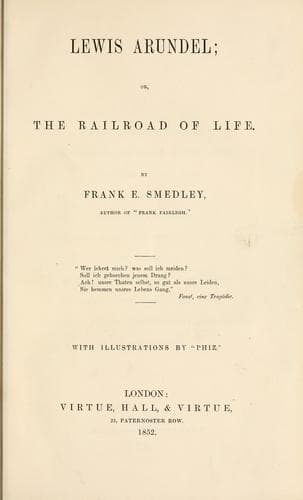
Lewis Arundel; Or, The Railroad Of LifeSmedley, Frank E. (Frank Edward)
General
Lewis Arundel; Or, The Railroad Of Life
Smedley, Frank E. (Frank Edward)
English fiction -- 19th century
“Really I have not sufficient knowledge of facts to inform you, but I
should say he is a very popular man.”
“Popular man! I hate that phrase,” returned his companion pettishly. “It
is almost as bad as describing any one as a man about town, which always
gives me the idea of a creature that wears a pea-jacket, lives at a
club, boards on cigars, talks slang, carries a betting-book, and never
has its hair cut. Can’t you tell me what you think of Mr. Leicester
yourself?”
“Well, I think him gentlemanly, good-natured, agreeable up to a certain
point, cleverish---”
^ “Yes, that will do; I quite understand. I don’t think you do him
justice--he has a kind heart, and more good sense than you are disposed
to give him credit for. You should not form such hasty judgments of
people; a want of charity I perceive is one of your faults. And now
I must wish you good-night; I hear my kind old chaperone anxiously
bleating after me in the distance.”
So saying she arose and hastened to put herself under the protection of
“a fine old English gentlewoman,” who, with a hooked nose, red gown,
and green scarf, looked like some new and fearful variety of the genus
Parroquet. At the same time, Bracy summoned Lewis to join the Prince,
who was about to depart, which, after Lady Lombard had in an enthusiasm
of gratitude uttered a whole sentence in the largest capitals, he was
allowed to do.
Leicester accompanied them, tearing himself away from Professor
Malchapeau, who had singled him out as a brother savan, and commenced
_raconte_-ing to him his affecting history, thereby leaving that shaggy
little child of misfortune to lament to his sympathising hostess the
melancholy fact that “Zie Professor Addiscombe had cut his little tale
off short, and transported himselfs avay in von great despatch.”
’Twere long to tell the jokes that were made, the new and additional
matter brought to light, as each of the quartette, assembled round a
second edition of supper in Bracy’s rooms, detailed in turn his own
personal experiences of the evening’s comicalities--the cigars that were
smoked, or the amount of sherry cobbler that was imbibed: suffice it
to say, that a certain lyrical declaration that they would not “go home
till morning,” to which, during their symposium, they had committed
themselves, was verified when, on issuing out into the street, the cold
grey light of early dawn threw its pale hue over their tired faces and
struggled with sickly-looking gas lamps for the honour of illuminating
the thoroughfares of the sleeping city.
Public-domain text, read in full here on John Shaqi.
Reviews
Reviews
No reviews yet
Be the first to share your thoughts on this work.
Elsewhere in the archive
Join the Discussion
Join the discussion
Sign in to leave a comment or review.
Sign InorCreate an account