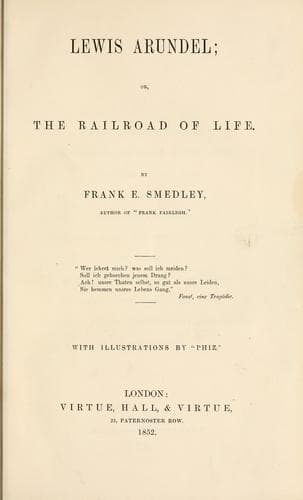
Lewis Arundel; Or, The Railroad Of LifeSmedley, Frank E. (Frank Edward)
General
Lewis Arundel; Or, The Railroad Of Life
Smedley, Frank E. (Frank Edward)
English fiction -- 19th century
and the bitter tears which no personal privations or misfortunes could
have forced from her, flowed down her cheeks as she reflected how these
bright anticipations seemed doomed never to be realised.
Unselfish by nature, and trained to habits of thoughtfulness by
witnessing her father’s life of daily self-sacrifice, Rose had never
been accustomed to indulge on her own account in those day-dreams so
common to the sanguine mind of youth. But the germs of that pride and
ambition which were Lewis’s besetting sins existed in a minor degree
in Rose’s disposition also, and found vent in a visionary career of
greatness she had marked out for her brother, and for which his unusual
mental powers and striking appearance seemed eminently to qualify him.
In nourishing these visions her father had unconsciously assisted, when
in moments of confidence he had imparted to her his hopes that Lewis
would distinguish himself in whatever career of life he might select,
and by his success restore them all to that position in society which
by his own imprudence he had forfeited. What a bitter contrast did the
reality now present! Rose had received that morning a letter from her
brother detailing his interview with General Grant and its results; and
though, from a wish to spare her feelings, he had been more guarded in
his expressions than on the occasion of his conversation with Frere
the preceding day, yet he did not attempt to disguise from her his
repugnance to the arrangement, or the degradation to which his haughty
spirit led him to consider he was submitting.
“Poor Lewis!” murmured Rose, “I know so well what misery it will be to
him; the slights, the hourly petty annoyances which his proud, sensitive
nature will feel so keenly; and then, to waste his high talents, his
energy of character and strength of will on the drudgery of teaching,
when they were certain to have led him to distinction if he had only
had a fair field for their exercise--it would have broken dearest papa’s
heart, when he had hoped so differently for him. But if _he_ had lived
this never would have been so. He often told me he had influential
friends, and though he never would apply to them on his own account,
he declared he would do so when Lewis should become old enough to enter
into life. I wonder who they were. He never liked to talk on those
subjects, and I was afraid of paining him by inquiring. I am glad there
is a Miss Grant: I hope she may prove a nice girl and will like Lewis;
but of course she will--every one must do that. Oh! how I hope they
will treat him kindly and generously--it will all depend upon that. Poor
fellow! with his impulsive disposition and quick sense of wrong--his
fiery temper too, how will he get on? And it is for our sakes he does
all this, sacrificing his freedom and his hopes of winning himself a
name. How good and noble it is of him!”
She paused, and leaning her brow upon her little white hand, sat buried
in deep thought. At length she spoke again.
Public-domain text, read in full here on John Shaqi.
Reviews
Reviews
No reviews yet
Be the first to share your thoughts on this work.
Elsewhere in the archive
Join the Discussion
Join the discussion
Sign in to leave a comment or review.
Sign InorCreate an account