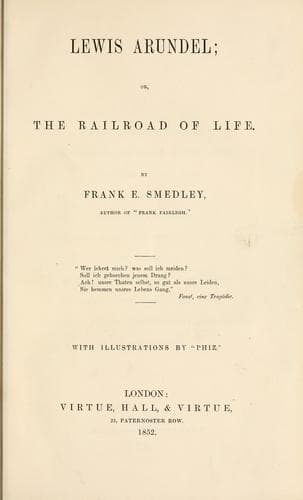
Lewis Arundel; Or, The Railroad Of LifeSmedley, Frank E. (Frank Edward)
General
Lewis Arundel; Or, The Railroad Of Life
Smedley, Frank E. (Frank Edward)
English fiction -- 19th century
Ah, no! this earth of ours
Was “very good,” and hath its blessings still;
And if we will,
We may be happy. Say, stern preacher, why
Should we then hate to live, or fear to die,
With Love for Time, Heaven for Eternity?
Rose perused them attentively, sighed deeply, and then resumed--
“Yes, _he_ liked them, and said (I remember his very words) there was
more vigour and purpose about them than in the general run of girlish
verses. How could I find out whether they are worth anything?” She
paused in reflection, then clasping her hands together suddenly, she
exclaimed--
“Yes, of course, Mr. Frere; he was so good and kind about the pictures,
and Lewis says he is so very clever, he will tell me. But may not he
think it strange and odd in me to write to him? Had I better consult
mamma?”
But with the question came an instinctive consciousness that she was
about the last person whom it would be agreeable to consult on such an
occasion. Rose, like every other woman possessing the slightest approach
to the artist mind, felt a shrinking delicacy in regard to what the
Browning school would term her “utterances,” which rendered the idea of
showing them where they would not be appreciated exquisitely painful to
her. Now, Mrs. Arundel had a disagreeable knack of occasionally brushing
against a feeling so rudely as to cause the unlucky originator thereof
to experience a mental twinge closely akin to the bodily sensation
yclept toothache.
It will therefore be no matter of surprise to the reader to learn that
Rose, after mature deliberation, resolved to keep the fact of her having
applied to Mr. Frere a secret, at all events till such time as the
result should become known to her.
She accordingly selected such of her poetical effusions as she deemed
most worthy, in the course of which process she stumbled upon a short
prose sketch, the only thing of the sort she had ever attempted,
it being, in fact, a lively account of her first appearance at a
dinner-party, written for the benefit of a young lady friend, but for
some reason never sent. This, after looking at a page or two, she was
about to condemn as nonsense, when an idea came across her that if Mr.
Frere was to form a just estimate of her powers, it was scarcely fair
to select only the best things; so she popped in the sketch of the
dinner-party as a kind of destitution test, to show how badly she
_could_ write.
Public-domain text, read in full here on John Shaqi.
Reviews
Reviews
No reviews yet
Be the first to share your thoughts on this work.
Elsewhere in the archive
Join the Discussion
Join the discussion
Sign in to leave a comment or review.
Sign InorCreate an account