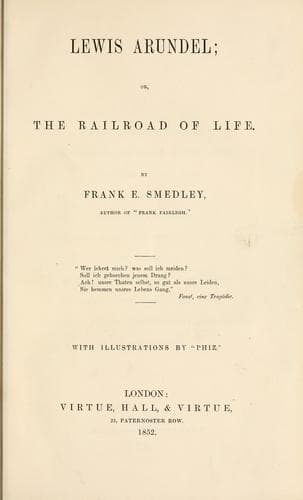
Lewis Arundel; Or, The Railroad Of LifeSmedley, Frank E. (Frank Edward)
General
Lewis Arundel; Or, The Railroad Of Life
Smedley, Frank E. (Frank Edward)
English fiction -- 19th century
mean to let the matter rest till I have succeeded, I consider myself
a partner in the concern. Lewis parted from me in high health and very
tolerable spirits. He left town, with General Grant, the same morning
on which I started for Cornwall. You shall hear from me again when I can
report progress. Don’t write any more nonsense about giving me trouble:
in the first place, the thing is no trouble; in the second, I should not
mind it one bit if it were.
“I am yours very truly,
“Richard Frere.”
The first thing next morning Frere called upon his friend the publisher,
who, as soon as he understood that nothing beyond advice was required of
him, became very communicative and agreeable; glanced his eye over the
verses and approved of them, though he added, with a Burleigh-like
shake of the head, that he wished they were anything but poetry. Frere
wondered why, and asked him. In reply he learned that the public mind
had acquired a sadly practical bias, which leading him to suggest that
poetry was the very thing of all others to bring it right again, he was
further informed that the evil was much too deeply seated to be affected
by so weak an application as the poetry of the present day; and the
truth of this assertion appearing undeniable, the subject was dropped.
“The best thing for you to do with these MSS., Mr. Frere,” continued his
adviser, “would be to get them inserted in some popular periodical.”
“Well, I don’t object,” returned Frere. “Which had I better send
them to? There’s ‘Gently’s Miscellany,’ and the ‘New Weekly,’ and
‘Gainsworth’s Magazine,’ and half-a-dozen more of’em.”
“What do you suppose would be the result of adopting such a line of
conduct?” inquired his friend.
“Why, as the things are in themselves good, they’d probably put ’em in
next month, and send a cheque for the amount, enclosed in a polite note
asking for more.”
“I fear not,” was the answer. “A very promising young friend of mine
sent a nicely written paper to the least exclusive of the periodicals
you have just mentioned; hearing nothing of it, he ventured at the end
of six months to write and inquire its fate. In reply he received a note
from the editor, which appeared to him more explicit than satisfactory.
It was couched in the following laconic terms:--‘Declined with thanks.’”
“Phewl that’s pleasant,” rejoined Frere. “What would you advise, then,
under the circumstances? I place myself quite in your hands.”
His friend leaned back in his chair and considered the matter deeply. At
length he seemed to have hit upon some expedient, for he muttered
with great emphasis, “Yes, that might do. He could if he would.
Yes--certainly!” Then turning suddenly to Frere, he exclaimed, “Mind,
you’ll never breathe a word of it to any living being!”
“Not for the world,” returned Frere. “And now, what is it?”
“You’ve heard of ‘Blunt’s Magazine’?”
“Yes; I’ve seen it in several places lately.”
Public-domain text, read in full here on John Shaqi.
Reviews
Reviews
No reviews yet
Be the first to share your thoughts on this work.
Elsewhere in the archive
Join the Discussion
Join the discussion
Sign in to leave a comment or review.
Sign InorCreate an account