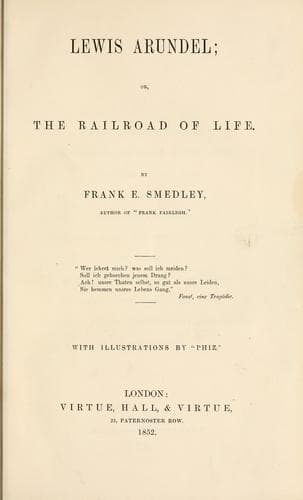
Lewis Arundel; Or, The Railroad Of LifeSmedley, Frank E. (Frank Edward)
General
Lewis Arundel; Or, The Railroad Of Life
Smedley, Frank E. (Frank Edward)
English fiction -- 19th century
“Why, Frere, is it you, man?” exclaimed Bracy in surprise. “As I’m a
sinner, I took you for that learned elder, Dr.-------. My young imp told
me you were a gentleman who wished to see me on particular business. If
that juvenile devil takes to telling lies _to_ instead of _for_ me,
I shall have to give him his due for once, in the shape of a sound
caning.”
“You may spare yourself the trouble,” returned Frere, “as by some
accident he has only spoken the truth this time; for I hope you don’t
mean to insinuate that I am anything but a gentleman, and I have most
assuredly come to you on business--that is, always supposing Mr. --------
of -------- Street has informed me correctly in regard to your
editorial functions.”
“What! has the _cacoethes scribendi_ seized you also, and tempted you
into the commission of some little act of light literature?” added
Bracy.
“Thank goodness, no,” answered Frere. “I’m happy to say I’m not so far
gone as all that comes to yet. No, this is a different case altogether,”
and he then proceeded to inform his companion of Rose’s, application,
and the necessity which existed to make her talents available for
practical purposes.
“Magazine writing affords rather a shady prospect for realising capital
in these days,” observed Bracy, shaking his head discouragingly. “Let’s
look at the young lady’s interesting efforts. Have you ever seen her?
Arundel’s sister ought to be pretty. What’s this? ‘The Preacher’s
Address to the Soul.’ Why, it’s a sermon in rhyme. Heaven help the girl!
what’s she thinking of?”
“Read it and you’ll see. I like it very much,” returned Frere, slightly
nettled at the reception his _protégées_ productions appeared likely to
meet with.
“Oh! it’s a sermon clearly,” continued Bracy; “here’s something about
vanity and the grave. I heard it all last Sunday at St. Chrysostom’s,
only the fellow called it gwave and gwace. He’d picked up some
conscientious scruple against the use of the letter R, I suppose.
It’s quite wonderful, the new-fangled doctrines they develop nowadays.
Hum--ha--‘Making the desert home,’--rather a young idea, eh? ‘Happy
birds,’--don’t like that, it puts one too much in mind of ‘jolly dogs’
or ‘odd fish.’ I should have said dicky birds, if it had been me; that’s
a very safe expression, and one that people are accustomed to. ‘The joy
of flowers,’--what on earth does she mean by that, now? I should say
nobody could understand that; for which reason, by the way, it’s the
best expression I’ve seen yet. Poetry, to be admired in the present day,
must be utterly incomprehensible. We insert very little, but that’s the
rule I go by. If I can’t understand one word of a thing, I make a point
of accepting it; it’s safe to become popular. ‘Love for time, Heaven for
eternity,’--well, that’s all very, nice and pretty, but I’m sorry to say
it won’t do; it’s not suited to the tone of the Magazine, you see.”
Public-domain text, read in full here on John Shaqi.
Reviews
Reviews
No reviews yet
Be the first to share your thoughts on this work.
Elsewhere in the archive
Join the Discussion
Join the discussion
Sign in to leave a comment or review.
Sign InorCreate an account