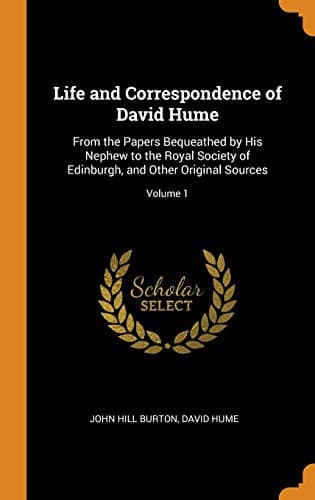
Life and Correspondence of David Hume, Volume 1Burton, John Hill
PhilosophyPhilosophy
Life and Correspondence of David Hume, Volume 1
Burton, John Hill
Hume, David, 1711-1776; Philosophers -- Great Britain -- Biography
men," "gentlemen who have some fortune and education, and the meanest
starving poor: without any considerable number of the middling rank of
men, which abounds more in England, both in cities and in the country,
than in any other quarter of the world."[198:1]
The history of the miserable quarrels and intrigues connected with
Hume's residence in the Annandale family, is a sad picture, not only of
the position of the individual, but of his class,--the poor scholars,
the servile drudges for bread. The modern literary labourer--or hack, as
he is called by those who deem the word labourer too respectable to be
employed on such an occasion--may look from the narrow bounds of his own
independent home, with a feeling of sincere though not boastful
superiority on David Hume, living in the splendid bondage of a peer's
mansion. But in drawing the comparison on which the reflection rests,
let him keep in view the state of literature and of society at that
period, and ask where lay the hopes of the literary labourer? If he
remained in the less conspicuous walks of learned industry, and became a
divine or a teacher, there was before him the career of Parson Adams,
taking his pot and pipe with the upper servants; or that of the
threadbare tutor, subjected to the caprice and insolence of young men,
who, if they do not happen to be endowed with a high tone of sentiment,
must imbibe from all around them this feeling, that they are as far
beyond the parallel of rank of their instructor, as the Brahmin is
beyond that of the Pariah; or, thirdly, he might be the hired victim of
a semi-maniac, whose few rays of remaining reason are but sufficient to
indicate his own immeasurable superiority to the bought attendant of his
humours. These were the resources of the man who distrusted the power of
his own genius to soar into the higher flights of original literature;
the man, who might perhaps be too conscientious, not to say also too
timid, to throw the chance of his being able to meet his obligations to
society and to perform his social duties, on the chance of his
succeeding in the race for literary distinction.
But suppose the race run and gained, and the laurels on the victor's
brow,--for what, then, has all been risked, all encountered? True, Hume
himself became one of the distinguished few who gained both fame and
fortune; but in the ordinary case, if the former were achieved, the
latter did not follow; and in seeking the types of literary distinction
in his age, Fielding, Goldsmith, and Johnson are the names that rise
before us. Was the garden in which these flowers bloomed so genial that
we would have others transplanted thither?
Public-domain text, read in full here on John Shaqi.
Reviews
Reviews
No reviews yet
Be the first to share your thoughts on this work.
Elsewhere in the archive
Join the Discussion
Join the discussion
Sign in to leave a comment or review.
Sign InorCreate an account