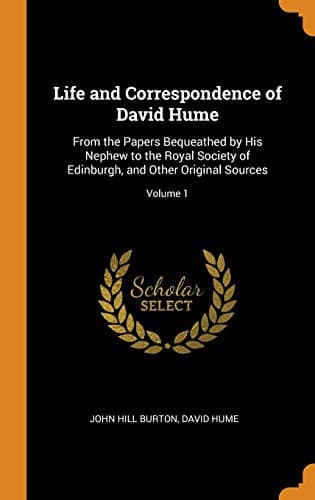
Life and Correspondence of David Hume, Volume 1Burton, John Hill
PhilosophyPhilosophy
Life and Correspondence of David Hume, Volume 1
Burton, John Hill
Hume, David, 1711-1776; Philosophers -- Great Britain -- Biography
When Hume examined, with more and more minuteness, the elements of the
materials on which the mind works, he could still find nothing but these
impressions and ideas. Looking at language as a machinery for giving
expression to thought, he thus established for himself a test of its
adaptation to its right use,--a test for discovering whether in any
given case it really served the purpose of language, or was a mere
unmeaning sound. As he found that there was nothing on which thought
could operate but the impressions received through sensation, or the
ideas left by them, he considered that a word which had not a meaning to
be found in either of these things, had no meaning at all. He looked
upon ideas as the goods with which the mind was stored; and on these
stores, as being of the character of impressions, while they were in the
state of coming into the mind. When any one, then, in reasoning, or any
other kind of literature, spoke of any thing as existing, the principle
of his theory was, that this storehouse of idealized impressions should
be searched for one corresponding to the term made use of. If such an
impression were not found, the word was, so far as our human faculties
were concerned, an unmeaning one. Whether there was any existence
corresponding to its meaning, no one could say: all that the sceptical
philosopher could decide was, that, so far as human intellect was put in
possession of materials for thought, it had nothing to warrant it in
saying, that this word represented any thing of which that intellect had
cognizance.
Public-domain text, read in full here on John Shaqi.
Reviews
Reviews
No reviews yet
Be the first to share your thoughts on this work.
Elsewhere in the archive
Join the Discussion
Join the discussion
Sign in to leave a comment or review.
Sign InorCreate an account