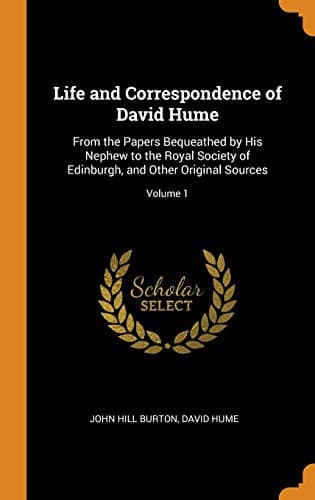
Life and Correspondence of David Hume, Volume 1Burton, John Hill
PhilosophyPhilosophy
Life and Correspondence of David Hume, Volume 1
Burton, John Hill
Hume, David, 1711-1776; Philosophers -- Great Britain -- Biography
The application of this system to the mathematics, and to natural
philosophy, was so startling as to afford to some readers almost a
_reductio ad absurdum_. The infinite divisibility of matter was
arraigned by Hume as so far from being a truth, that it was not even
capable of being conceived by the mind, which had never yet received any
impressions through the senses corresponding to the expression. Every
man had seen matter divided--some into smaller fragments than others;
but where our ideas, derived from actual experiment, stopped in
minuteness of division, the conception of divisibility stopped also. The
truth of geometrical demonstration, as applicable to practice, he did
not deny; but he maintained, or rather seemed to maintain, for his
reasoning here is of a highly subtle order, that we have a conception of
these operations only in as far as they concur with really existing
things, or, more properly speaking, with the ideas in the mind conveyed
thither by the senses. Of the point, which has no breadth, depth, or
length; of the straight line, which is deficient in the first and
second, and not in the last of these qualities, he denied that we could
have an idea, unless that idea were just as much the representative of
an actual existence as any other idea is.
Infinity of space was an expression to which he had an objection on
similar grounds; it had no idea corresponding to it lodged in the mind.
Of space finite in various quantities, the mind possessed ideas stored
up from repeated impressions, and by adding these ideas together, more
or less vastness in the conception of finite space was afforded. But any
thing beyond this definitive increase, attested as it was by the senses,
the mind had no means of conceiving. Whatever might be in another
intellectual world, there was no idea corresponding to infinity of space
in the mind of man. It thence followed, that space unoccupied was a
conception of which the mind was incapable, because the impressions
originally conveyed to the mind were the medium through which the
conception of space existed, and where there were no ideas of such
impressions, an aggregate idea of space was wanting. In the same manner
it was held, that it was in a succession of impressions, with ideas
corresponding, that the conception of time consisted, and that without
such a succession, time would be a thing unknown and unconceived. Our
ideas of numbers he found to be but the collected ideas of the
impressions of the units of which the senses have received distinct
impressions; and in confirmation of this he appealed to the distinctness
of our notion of small numbers, which our mind has been accustomed to
find represented by units, and our imperfect conception of those large
numbers, which we have never had presented to us in detail. How readily
we have a notion of six, but how imperfectly the mind receives the
conception of six millions; how clearly we perceive, in units, the
Public-domain text, read in full here on John Shaqi.
Reviews
Reviews
No reviews yet
Be the first to share your thoughts on this work.
Elsewhere in the archive
Join the Discussion
Join the discussion
Sign in to leave a comment or review.
Sign InorCreate an account