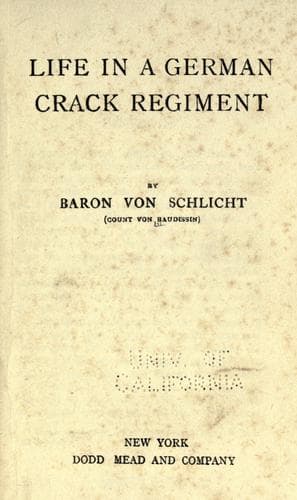
Life in a German Crack RegimentBaudissin, Wolf Ernst Hugo Emil, Graf von
General
Life in a German Crack Regiment
Baudissin, Wolf Ernst Hugo Emil, Graf von
Germany. Heer -- Military life -- Fiction; Soldiers -- Fiction
"I do not know," acknowledged Fritz, "but some means may be found.
The Cadets' Colleges must, as I have said, be abolished, and every
officer must have passed his matriculation, as was formerly the case
in the Marines. There should be a limit of age; in my opinion it
should be twenty, and then a man could not be a lieutenant till he
was two-and-twenty; that is quite early enough, if after that age was
no more taken into account. The age limit must be abolished. To-day
no one who has not reached a certain rank by a certain age has any
chance of making a career for himself. What is the object of keeping
the army so young by all possible means? As a result of this, every
year hundreds and hundreds of men have to seek for posts of all
kinds. New elements, new officials, new views are introduced, and
this does not tend to facilitate the training of the troops. If a man
is lieutenant at twenty-two he can be a captain at five-and-thirty, a
major at forty-four, and a colonel at eight-and-forty. Surely that is
young enough, isn't it? And if he distinguishes himself in any way he
can get his promotion earlier."
"And would that make for efficiency in time of war?"
"You can answer that better than I can. You were pensioned as
a complete invalid, but in spite of this were you not at your
discharge quite young enough and active enough to have done duty on
the field?"
"Yes, and no," grumbled the major. "I will explain what I mean. The
chief army doctor worried round me for a long time, but he could find
no wound for which he could write a certificate, so I assisted him a
little and mentioned injuries which I did not possess, and then it
was all right. But I could easily have held out for five--no, ten
years. Go into a pension office in any large town and look at the
innumerable officers who go there regularly at the first of each
month to draw their pension--a few miserable pounds. They are all
'complete invalids,' or who have been pensioned on account of their
age. Yet health and energy are to be read in their faces."
"That is just what we all say," put in Fritz. "We have been lately
talking about these things in the Casino; nothing of much value is
said, still it is interesting what the different officers think about
these matters. We are unanimous in wanting to abolish the military
college. Every lieutenant must have passed his matriculation and no
one can be an officer before he is one-and-twenty; if we once have
that, there will be a great alteration in the army."
There was a long pause; the major was ruminating over what Fritz had
just said, then he said: "In many ways you have really most sensible
ideas."
"That is what I think," Hildegarde chimed in; "I must compliment
you, Fritz. When I hear you speak so seriously, and with so much
knowledge, I can hardly recognise you as my gay and frivolous
brother."
Public-domain text, read in full here on John Shaqi.
Reviews
Reviews
No reviews yet
Be the first to share your thoughts on this work.
Elsewhere in the archive
Join the Discussion
Join the discussion
Sign in to leave a comment or review.
Sign InorCreate an account