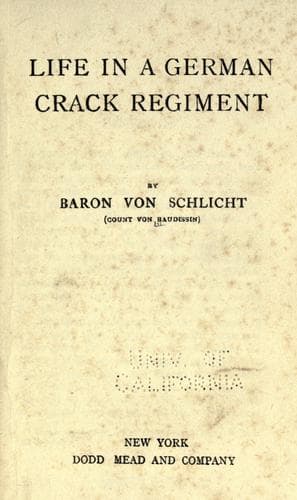
Life in a German Crack RegimentBaudissin, Wolf Ernst Hugo Emil, Graf von
General
Life in a German Crack Regiment
Baudissin, Wolf Ernst Hugo Emil, Graf von
Germany. Heer -- Military life -- Fiction; Soldiers -- Fiction
He had also told himself hourly that even when he returned he did not
think he could see him in cold blood, and thus to a certain extent
he breathed more freely when he heard of Willberg's death, and he was
almost grateful to Heaven for having spared him a future meeting.
It was sad, of course, that Willberg had been obliged to take his
life when he was still a young man, but as far as the army and the
officers were concerned his death was no loss. He had dreaded meeting
him again, but now he returned to the garrison quite cheerfully.
Fourteen happy days lay behind him; Olga and he had thoroughly
enjoyed themselves in beautiful Paris; his furlough had been a real
time of refreshment, and he was quite pleased to return to his duties
and his active life.
"The colonel desires that Lieutenant Winkler will speak to him
to-morrow at eleven in the regimental bureau." For a moment George
was somewhat alarmed. Could the colonel have found out that he had
been in France, in Paris, without permission? Well, the punishment
for that was not severe, at the worst a few day's confinement to
one's own lodgings, which would not destroy the memory of the
delightful days he had just enjoyed.
The first words, however, which the colonel addressed to him next
morning showed him that his fears were groundless. He inquired how he
had enjoyed the Riviera, and then he came at once to the point. He
told him what Willberg's former servant had said, and begged George
to give him any further information he had. "Above all it is most
important for me to know what was in the letter which Willberg sent
you. Can you, and will you, give me information concerning this?"
George considered for a moment, then he said: "As I was not expressly
pledged to keep silence I do not think I shall be committing an
indiscretion if I tender an account of it."
"Have you still Willberg's letter?"
"No, sir; but I perfectly remember what it contained. Lieutenant von
Willberg wrote to me that he had been gambling and required five
thousand marks (£250) to settle a debt of honour. If he did not get
the money by some means or other he said he should have to put a
bullet through his head to vindicate his honour."
"This confounded gambling!" cursed the colonel. "Who will extirpate
it root and branch?" After a slight pause he asked: "Did you give him
the money?"
"No, sir."
"The gambling debt was paid by some other means," interposed Count
Wettborn; "the colonel therefore need not have any anxiety about that
matter."
The colonel breathed more freely. "Well, I am glad of that." Then he
turned to George again: "You did not give him the money then? Might I
ask why? Do not misunderstand me; it is, of course, your own affair
whether you lent Willberg the money or not; but I thought perhaps
you would have given it him on this occasion. But perhaps you did not
think he was serious in saying he would take his life?"
Public-domain text, read in full here on John Shaqi.
Reviews
Reviews
No reviews yet
Be the first to share your thoughts on this work.
Elsewhere in the archive
Join the Discussion
Join the discussion
Sign in to leave a comment or review.
Sign InorCreate an account