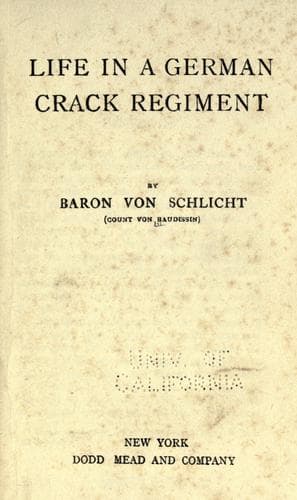
Life in a German Crack RegimentBaudissin, Wolf Ernst Hugo Emil, Graf von
General
Life in a German Crack Regiment
Baudissin, Wolf Ernst Hugo Emil, Graf von
Germany. Heer -- Military life -- Fiction; Soldiers -- Fiction
The colonel could only offer as an excuse the fact that little
Willberg had not only been able to deceive him but also all his
fellow-officers, and this had somewhat modified His Majesty's anger.
"But all the same it is a great scandal." The colonel was dismissed
from his presence without a gracious word, and he trembled for his
career, but the adjutant was able to console him. If the colonel was
to have received his discharge he would have had it already, and now
that the colonel had seen His Majesty it was a matter of perfect
indifference what the brigades and divisions were saying. Nothing
would now happen to either the colonel or himself; indeed, he could
not have been made personally responsible for what had occurred.
Still, he was very glad that George was pledged to silence. For
otherwise many more things connected with the gambling might have
come to light. It might, indeed, have cost him his post, that he,
in the character of the adjutant of the regiment, had not merely
permitted gambling in the Casino, but had to a certain extent
participated in it. He was therefore greatly relieved that the affair
had blown over so easily, and he made up his mind on the next
suitable occasion to put in a good word for George and to say to the
officers, "Boys, Winkler's behaviour has been blameless; I do not, of
course, wish to influence you in any way, but I ask you to consider
whether in future you will not be on more friendly terms with him."
When next day, however, the count delivered his carefully-thought-out
address to the officers he evoked no reciprocal feeling. Every
one of them would have done what Winkler did--why then was there
anything special in it? And as he could not say what he knew touching
Willberg's honour one really could not judge whether the thing was
so bad, and to bring charges against a man without giving proof was
really not exactly the proper thing to do. Either he should have said
all or nothing.
The officers continued talking in this way, and the count heard
their criticisms with surprise and annoyance. At last he said very
seriously: "Gentlemen, I can only repeat that, in the opinion of
the colonel, and also in my own, Lieutenant Winkler has acted
perfectly rightly. If you think that you have the slightest ground
for complaint against him I can only assure you you are wrong, and
I advise you most earnestly not to express to Winkler the views you
have just uttered. There might be results that would not be agreeable
to you. I beg you to pay attention to what I have said."
Public-domain text, read in full here on John Shaqi.
Reviews
Reviews
No reviews yet
Be the first to share your thoughts on this work.
Elsewhere in the archive
Join the Discussion
Join the discussion
Sign in to leave a comment or review.
Sign InorCreate an account