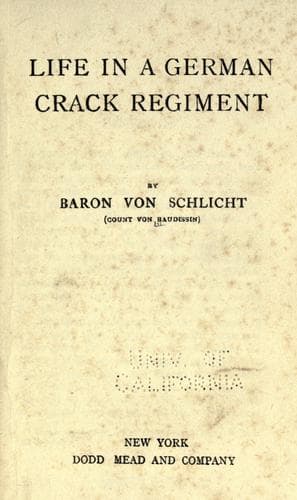
Life in a German Crack RegimentBaudissin, Wolf Ernst Hugo Emil, Graf von
General
Life in a German Crack Regiment
Baudissin, Wolf Ernst Hugo Emil, Graf von
Germany. Heer -- Military life -- Fiction; Soldiers -- Fiction
"I am not sure that I have the right to ask you to inform the colonel
of what I have just told you, but I will be responsible for that.
Perhaps he will speak to the officers and tell them that he knows
everything and approves of my conduct. Perhaps that will have the
desired result."
"It must; I will ask the colonel to talk seriously to the officers,
and if they will not listen to reason of their own free will they
must be forced to hear it."
"Thank you, sir."
The adjutant turned to go and shook hands with George. It was the
first time that the count had offered him his hand, the first
friendliness that he had received for a long time, the first time
that anyone had spoken to him warmly and heartily and sympathised
with him. It did not alter things, of course, but in spite of that
George felt happier and gayer than he had been for a long time,
and the feeling of having acted rightly in the matter gave great
satisfaction.
Olga scarcely recognised him when she came in that evening; she had
visited him almost daily lately, for George sat at home evening
after evening and thought and meditated on what would happen. He had
accepted no invitations, gone nowhere; he had lived in himself, and
spent much time in writing long letters to his parents, in which
he lamented his misfortunes. It was a necessity of his nature to
express his feelings to the people who cared for him, but regularly
as the letters were written Olga threw them into the fire. "Your
parents cannot help or advise you," she had answered him on the first
occasion when she destroyed his letter, and he saw that she was quite
right.
To-day when she came she asked if he had finished his letter, and she
could hardly believe it when he said he had not written one at all.
"Whatever has happened then?"
He told her of the conversation he had had with the adjutant, and
asked her at the end: "Do you think people ought to know how Willberg
treated you?"
Olga sat thinking for a long time, then she said: "I care for you
very much, I would gladly give you permission to speak openly, but it
would not be wise, especially on your account. What do our relations
with one another matter to the world? Nobody expects a young
lieutenant to be a saint, but he need not publish to the whole world
the fact that he has a 'friend,' and certainly no one need know what
her name is and what has happened to her. There would be people who
would blame you, and why should you expose yourself to that?"
He kissed her on the forehead. "You are right, as you always are."
He could not tell how it was, but suddenly he wondered how Hildegarde
would receive such news. He had not seen her since his return, but
daily his thoughts had wandered to her, and now he saw her picture
clearly before him.
"George, what are you thinking about so seriously?"
He roused himself from his thoughts and found Olga standing in front
of him and laughing.
Public-domain text, read in full here on John Shaqi.
Reviews
Reviews
No reviews yet
Be the first to share your thoughts on this work.
Elsewhere in the archive
Join the Discussion
Join the discussion
Sign in to leave a comment or review.
Sign InorCreate an account