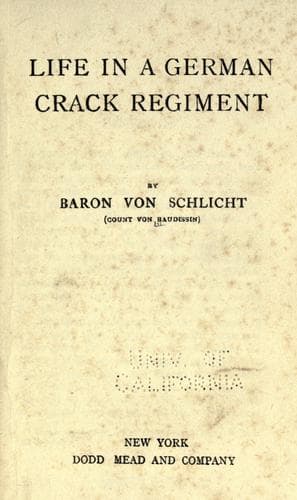
Life in a German Crack RegimentBaudissin, Wolf Ernst Hugo Emil, Graf von
General
Life in a German Crack Regiment
Baudissin, Wolf Ernst Hugo Emil, Graf von
Germany. Heer -- Military life -- Fiction; Soldiers -- Fiction
Baron Gersbach, the Uhlan, did not come, though Count Wettborn
personally invited him, and promised him a long night of gambling.
But Baron Gersbach still declined. "Do not take it as an offence, my
dear count, but affairs are not quite as they ought to be in your
regiment; too much about them has got into the newspapers, and who
can guarantee that one of your men or one of your non-commissioned
officers who is occupied in attending on us will not run round to a
newspaper and relate piping hot all that we have been doing. When one
of your lieutenants, through a perfectly inexcusable indiscretion,
draws down upon you such a scandal, one cannot any longer wonder if
your men do the same thing. Well, I don't want any of that, thank
you. I have no desire to get into the newspapers; I can assure you
I was delighted to get off so easily when Willberg disappeared from
this earthly scene. Do not be vexed with me for speaking so frankly,
but as long as you have such people among you as Winkler, we cannot
keep up friendly relations with you."
In vain Count Wettborn sought to say a good word on behalf of George,
but it was of no avail.
"Certainly, he has the best intentions," agreed the Uhlan; "but good
intentions alone are not sufficient; as sensible and experienced
men, one must consider consequences. Now the consequences of his
actions you know better than I do, and the whole affair is by no
means pleasant for us. As Guard regiments we form one whole, and,
therefore, what affects one casts its shadow on the others likewise,
for people do not say such and such a thing happened in the 'Golden
Butterflies,' but simply 'in the Guards.' Such a thing is frightful,
for more than all the other regiments we must maintain outwardly,
at any rate, a good reputation. Something more than the ordinary
performance of our military duties is demanded from us, and,
therefore, we are sometimes obliged to act with exceptional severity
against our men. And then suddenly an idealistic reformer comes
along, who wants to do away with all cuffs and blows; that is all
very well in theory, but when it provokes open scandal, one simply
can't have anything more to do with him."
So the count was obliged to depart without having obtained his
object, and though until then, from a feeling of justice, he had been
the only one who took George's part, he now came to the conclusion
that it was impossible for Winkler to remain any longer in the
regiment.
With this idea in his mind the count spoke one day to the colonel.
"We can't go on much longer like this, sir, we are almost boycotted,
we shall never get another guest as long as Winkler is here. He has
brought us and himself, let alone everyone else, into discredit.
Formerly one could not allege anything against him except his
plebeian descent, but now there is a very strong feeling among the
officers that he only lodged the complaint because he is plebeian."
Public-domain text, read in full here on John Shaqi.
Reviews
Reviews
No reviews yet
Be the first to share your thoughts on this work.
Elsewhere in the archive
Join the Discussion
Join the discussion
Sign in to leave a comment or review.
Sign InorCreate an account