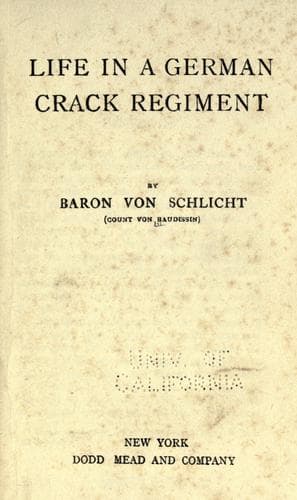
Life in a German Crack RegimentBaudissin, Wolf Ernst Hugo Emil, Graf von
General
Life in a German Crack Regiment
Baudissin, Wolf Ernst Hugo Emil, Graf von
Germany. Heer -- Military life -- Fiction; Soldiers -- Fiction
He sank into a chair and looked gloomily in front of him. Had he the
slightest ground for proceeding against Willberg? He might of course
say to him: "I know a young girl, and am aware that you have treated
her like a blackguard." Willberg could not possibly allow this
insult to pass unnoticed; there would be, at the least, a quarrel,
probably a duel, and, as a result, an investigation by a Court of
Honour. A good deal of dirt would be thrown about, but what would
be the use of that? Willberg would most likely be dismissed from
the army, and what then? What advantage would that be to anybody?
There would be one less dishonourable man in the army certainly, but
who would have to bear the consequences of that? Only George, for
he would never be pardoned for having acted so harshly towards the
darling of the regiment. Willberg after his dismissal would still
find faithful friends enough who would help him. He would not suffer
too excessively in no longer wearing officer's uniform. No, George
could take no steps against him, he had no case against him; he was
obliged to admit to himself that personally Willberg had done him no
harm, no injury, and if he stepped in on behalf of Olga's honour, the
town and the world would shake their heads, and the colonel would
make it quite clear to him that men do not fight a duel on account of
a young woman like Olga. She was certainly an excellent, worthy young
woman, she was under a talented actress, but still--in imagination
George heard their remarks, and he doubled up his fists in a fury of
rage. Then another thought occurred to him. What would his parents,
what would Hildegarde say, when they learnt that he had fought
a duel for the sake of his mistress? They must not know anything
whatever about the matter.
For nearly five minutes George sat deeply immersed in thought, and
Olga watched his expression with intense anxiety: her reputation, her
career, were at stake. What had taken place between her and Willberg
was known only to themselves and George; she had told no one about
it; she had never mentioned the name of her betrayer. If George
thought the affair ought not to rest with him, and that he ought to
inform the Court of Honour concerning it, then she would be forced
to absolve him from his promise, and the whole town would learn in
a few days what up till to-day was a secret. She would not be able
to remain in Berlin; she felt that she could never again face an
audience who knew how she had been treated.
"Well, George," she said at last, "have you yet made up your mind
what you are going to do?"
Public-domain text, read in full here on John Shaqi.
Reviews
Reviews
No reviews yet
Be the first to share your thoughts on this work.
Elsewhere in the archive
Join the Discussion
Join the discussion
Sign in to leave a comment or review.
Sign InorCreate an account