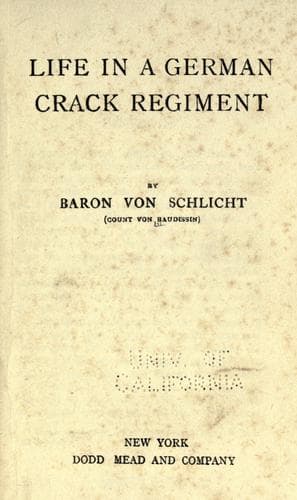
Life in a German Crack RegimentBaudissin, Wolf Ernst Hugo Emil, Graf von
General
Life in a German Crack Regiment
Baudissin, Wolf Ernst Hugo Emil, Graf von
Germany. Heer -- Military life -- Fiction; Soldiers -- Fiction
Hildegarde parried the question; what could she really say? It was
certainly very likely that George, when he had got to know her
better, would one day ask for her hand in marriage, and that was the
only thing she could say. But she read in her parents' faces such
fear, and yet such hope, that she had not the heart to deprive them
of their joy. Suddenly she thought of a way out of the difficulty.
She briefly referred to George, and then spoke at length concerning
another very rich man who had lately paid her an immense amount of
attention.
"But, dear child, your aunt has never told me a word about this, and
she always keeps me informed as to the admirer of the hour."
"Oh, that is what she does," thought Hildegarde. Then she said:
"Mamma, I don't want you to write to aunt about this; oddly enough
she hasn't noticed this gentleman's attentions to me, and I did not
tell her anything about it. You know what aunt is; she means to do
the very best for me, and in her efforts to help me, perhaps she goes
too far and spoils things."
"And what is his name? What is he?" inquired her mother.
Hildegarde blushed scarlet. "Please do not ask me; I don't want to
talk about it while the thing is still so uncertain."
"Quite right, my child," commended the major, "one ought not to talk
about things until they are settled"; and turning to his wife he
continued, "Do not press Hildegarde any more. If she does not want to
talk about it you may be sure she has good reasons." Then he shook
hands with his daughter. "Thank you, dear Hilda, that in honour of
this day you give me _this pleasure_; two celebrations instead of
one. Ah, it will probably soon be all settled"; and then he added,
with a deep sigh, "But it's high time, I can tell you, Hilda, I could
not hold out much longer."
Her mother also sighed and said gently:
"Hilda, you have no idea what terrible times we have been through
while you were in Berlin. Just think of it, the municipal authorities
were about to issue a distress warrant for the taxes, and your father
had to strain every nerve to get an adjournment."
"Yes, indeed, that was a stiff bit of work, I can tell you, and if I
had not been able to make use of my well-known name, God knows the
fellow would have seized my last bit of furniture; those people have
no mercy."
"None to the common people, at any rate," Hildegarde interposed.
"And they are quite right," affirmed the major; "the State cannot
live without taxes, and if it were to take under its protection
every working man and tradesman who is behindhand with his taxes,
where would that lead to? We should soon run dry and have no money
for soldiers, pensions and other important things. The State must
be without mercy, and if it makes an exception in our case it does
so because it knows perfectly well that it can do so; an aristocrat
always does his duty towards the State and his fellow-creatures."
Public-domain text, read in full here on John Shaqi.
Reviews
Reviews
No reviews yet
Be the first to share your thoughts on this work.
Elsewhere in the archive
Join the Discussion
Join the discussion
Sign in to leave a comment or review.
Sign InorCreate an account