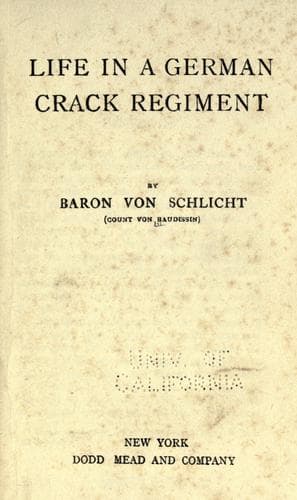
Life in a German Crack RegimentBaudissin, Wolf Ernst Hugo Emil, Graf von
General
Life in a German Crack Regiment
Baudissin, Wolf Ernst Hugo Emil, Graf von
Germany. Heer -- Military life -- Fiction; Soldiers -- Fiction
"I don't think anyone else, at least no one in my regiment, could;
they are all in debt, some more, some less. I should say that 75
per cent. of all the lieutenants from time to time do confess to
their parents, then a couple of thousands or so are paid--naturally
each time they say it is the very last--and the son is once more on
his legs again. Now, if one multiplies by seven the amount that the
others pay yearly in debts, it amounts to a pretty big sum of money.
With me the matter is somewhat more complicated, because I have
never paid a farthing, and when one is in such a plight as I am one
naturally has to pay very high interest. The last time, in spite of
great skill and cunning, I received a thousand marks when I gave an I
O U for three thousand."
"Still, that's something," laughed his father.
Involuntarily Fritz joined in the laugh, then he became serious again
and asked, "How are things with you, father?"
The major smoked on furiously for a moment. "Don't ask me, my son,
things are very bad indeed with me."
The old gentleman looked so full of despair that Fritz felt sincere
sympathy, "Poor father, all will soon be better again."
"Perhaps so; but will you believe it, that in spite of the fact that
I am not a man of prejudice, I cannot bear the idea of accepting
money from my son-in-law, not only to pay my debts, but in order to
exist?"
Fritz looked at him with astonishment. "I cannot understand it."
"That is because you are a young lieutenant, unmarried, and have no
one in the world to look after but yourself. But consider me, I am
an old man of sixty. For more than ten years I have been pensioned;
at eight I entered the army as a cadet. I have therefore worn the
soldier's uniform for over forty years, and during the whole time I
have exercised and drilled recruits, done my duty on parade, taken
part in three campaigns. And what is the result of it all? To be
dismissed with a pension on which one cannot live if he has a wife
and child. Pensioned off with four thousand marks. I ask you, what
are four thousand marks to-day? Now, things are said to be better,
the pensions are to be increased--well, let us say there is an
addition of one thousand five hundred marks--it won't in any case
be more, probably not so much. What then? Even six thousand marks
are not sufficient to defray the household expenses of a family, are
they? In a little town, perhaps, if one lives extremely modestly.
But has one grown old, has one worn out one's bones for years in
peace and in war, in order that in one's old age one must suffer
one deprivation after another merely to prolong life? There is an
old saying that the sweets of youth are not a good preparation for
the black bread of old age. And we pensioned officers in our youth
tasted mostly nothing but sweets. Certainly there were notable
exceptions who managed on their allowance, who were economical and
sober, but most lived in a happy-go-lucky fashion and enjoyed all the
Public-domain text, read in full here on John Shaqi.
Reviews
Reviews
No reviews yet
Be the first to share your thoughts on this work.
Elsewhere in the archive
Join the Discussion
Join the discussion
Sign in to leave a comment or review.
Sign InorCreate an account