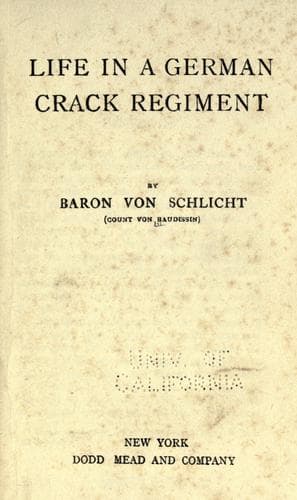
Life in a German Crack RegimentBaudissin, Wolf Ernst Hugo Emil, Graf von
General
Life in a German Crack Regiment
Baudissin, Wolf Ernst Hugo Emil, Graf von
Germany. Heer -- Military life -- Fiction; Soldiers -- Fiction
The major and his son were somewhat silent at supper; the mother
told all about the visits she had paid with Hildegarde, and as her
husband was in an amiable frame of mind she thought this would be a
favourable moment for him to bear the disappointment of learning that
the Warnows had only sent him six thousand marks. So she told him
about it, and also that she had changed the cheque in the bank.
"Well, it's not much, certainly, but it's something," averred the
major. "Let me have the money."
His wife objected. "Let me keep it till to-morrow, then we will talk
over things quietly and consider whom we must pay."
"Paying is all very well," said Fritz, "but surely you wouldn't be so
stupid, now that you have a few pence in your pockets, to fling them
away again. If you pay one person all the others will come running to
the house to-morrow, in honour of the Dad's birthday. Whoever would
be so stupid as to pay debts?"
His father quite agreed with him. "Fritz is right, Fritz is a
sensible fellow. The crew have waited all this time for their money
and can certainly wait a few weeks longer until Hilda is engaged. To
your health, Hilda!"
Fritz also raised his glass. "Long life to your future husband! By
the way what's his name? Not that it matters; the thing is, he has
money."
But Hildegarde did not lift her glass, she would like to have got up
from the table, she could not bear the way they talked about her, and
she could hardly refrain from bursting into tears. What would George
think if he knew how they drank his health and how they only thought
of his money and not of himself?
"Well, if you won't drink with us, leave it alone," said Fritz, and
emptied his glass.
The major returned to the subject of the money. "My dear, with
that money we might really have a nice little holiday; for three
years we have not stirred from this miserable hole. We would leave
two thousand marks at home, so that when we returned we were not
penniless, and the rest we would take with us and go for a few weeks
to Italy."
The idea was very agreeable to his wife, but she said, however,
"Later, perhaps, when Hilda is engaged. Remember the engagement may
take place any day, and we must be here to receive the dear man with
open arms."
"We will do that, certainly," said the major, "we'll embrace him. He
will be astonished how affectionately we hold him, won't he, Fritz?"
And turning to his wife he went on: "Just imagine, mother, that rogue
Fritz is forty thousand marks in debt." And he burst out laughing at
his son.
His mother clasped her hands, horrified. "But Fritz, how is that
possible?"
And, Hildegarde, astounded, burst out: "What on earth do you do with
the money from home that uncle sends you?"
"'Ask the stars that all things know,'" Fritz began to hum, but
he could not recollect the tune, so he only hummed a couple of
inarticulate notes.
Public-domain text, read in full here on John Shaqi.
Reviews
Reviews
No reviews yet
Be the first to share your thoughts on this work.
Elsewhere in the archive
Join the Discussion
Join the discussion
Sign in to leave a comment or review.
Sign InorCreate an account