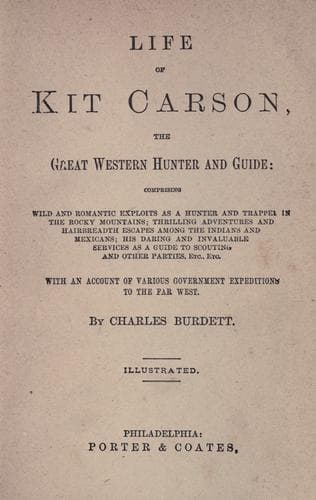
Life of Kit Carson, the Great Western Hunter and GuideBurdett, Charles
History
Life of Kit Carson, the Great Western Hunter and Guide
Burdett, Charles
Carson Kit, 1809-1868; Frontier and pioneer life -- West (U.S.)
The valley appears to be a plain, but is intersected by many ravines,
which flow into the Rio Grande on its western side. There is no timber,
but in the mountains it is abundant, and of excellent quality. The
population in the whole valley numbers scarcely more than ten thousand,
and as their farming operations require but a portion of the soil, the
larger part of the land is still wild, and grazed only by horses,
cattle, and sheep, which are raised in large numbers.
They are obliged to expend much labor upon their crops, as the climate
is too dry to mature them without irrigation; and yet in their community
of interest, in a country without fences, they find much satisfaction in
rendering kind offices to each other; and social life is more cultivated
than in communities whose interests are more separate. The high
altitude, and dryness of the atmosphere, render the climate exceedingly
healthful, rather severe in winter, but very mild and salubrious in
summer, so that disease is scarcely known in the valley.
The dress of the people has changed very much since the population
became partially Americanized, so that often the buckskin pants have
given place to cloth, and the blanket to the coat, and the moccasin to
the leathern shoe, and the dress of the women has undergone as great a
change. They are learning to employ American implements for agriculture,
instead of the rude Egyptian yoke fastened to the horns of the oxen; and
the plough composed of a single hooked piece of timber, and the axe that
more resembles a pick, than the axe of the American woodsman; and the
cart, whose wheels are pieces sawed from the butt end of a log, with a
hole bored for the axle, whose squeaking can be heard for miles, and
which are themselves a sufficient burden without any loading. Their diet
is simple, as it is with all Mexicans, consisting of the products of the
locality, with game, which is always to be included in a bill of fare
such as Carson would furnish; corn, and wheat, and peas, beans, eggs,
pumpkins, and apples, pears, peaches, plums, and grapes, constitute the
principal products of their culture. Their great source of enjoyment is
dancing, and the fandango is so much an institution in a town of the
size of Taos, that, during the winter, scarcely a night passes without a
dance. This is doubtless familiar to the reader, as the acquisition of
California has introduced a knowledge of the customs of its natives to
every eastern household.
In the spring of 1845, Carson had decided to commence the business of
farming at Taos, and had made the necessary arrangements for building a
house, and for stocking and planting, when an express arrived from Col.
Fremont, bringing despatches to remind him of his promise to join a
third exploring expedition, in case he should ever undertake another,
and to designate the place where he would meet the party Fremont was
organising.
Public-domain text, read in full here on John Shaqi.
Reviews
Reviews
No reviews yet
Be the first to share your thoughts on this work.
Elsewhere in the archive
Join the Discussion
Join the discussion
Sign in to leave a comment or review.
Sign InorCreate an account