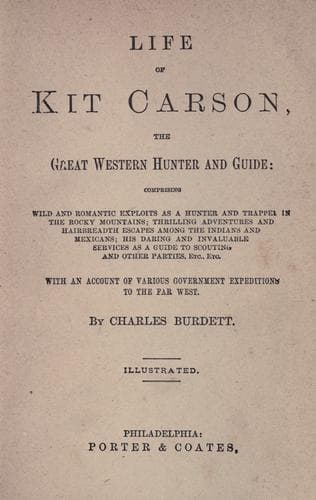
Life of Kit Carson, the Great Western Hunter and GuideBurdett, Charles
History
Life of Kit Carson, the Great Western Hunter and Guide
Burdett, Charles
Carson Kit, 1809-1868; Frontier and pioneer life -- West (U.S.)
Traveling along, they came suddenly upon broad and deeply-worn trails,
which had been freshly traveled by large bands of horses, apparently
coming from the settlements on the coast. These and other indications
warned them that they were approaching villages of the Horse-Thief
Indians, who appeared to have just returned from a successful foray.
With the breaking up of the missions, many of the Indians had returned
to their tribes in the mountains. Their knowledge of the Spanish
language, and familiarity with the ranches and towns, enabled them to
pass and repass, at pleasure, between their villages in the Sierra and
the ranches on the coast. They very soon availed themselves of these
facilities to steal and run off into the mountains bands of horses, and
in a short time it became the occupation of all the Indians inhabiting
the southern Sierra Nevada, as well as the plains beyond.
Three or four parties would be sent at a time from different villages,
and every week was signalized by the carrying-off of hundreds of horses,
to be killed and eaten in the interior. Repeated expeditions had been
made against them by the Californians, who rarely succeeded in reaching
the foot of the mountains, and were invariably defeated when they did.
As soon as this fresh trail had been discovered, four men, two Delawares
with Maxwell and Dick Owens, two of Fremont's favorite men, were sent
forward upon the trail. The rest of the party had followed along at
their usual gait, but Indian signs became so thick, trail after trail
joining on, that they started rapidly after the men, fearing for their
safety. After a few miles ride, they reached a spot which had been the
recent camping ground of a village, and where abundant grass and good
water suggested a halting place for the night, and they immediately set
about unpacking their animals and preparing to encamp.
While thus engaged, they heard what seemed to be the barking of many
dogs, coming apparently from a village, not far distant; but they had
hardly thrown off their saddles when they suddenly became aware that it
was the noise of women and children shouting and crying; and this was
sufficient notice that the men who had been sent ahead had fallen among
unfriendly Indians, so that a fight had already commenced.
It did not need an instant to throw the saddles on again, and leaving
four men to guard the camp, Fremont, with the rest, rode off in the
direction of the sounds.
They had galloped but half a mile, when crossing a little ridge, they
came abruptly in view of several hundred Indians advancing on each side
of a knoll, on the top of which were the men, where a cluster of trees
and rocks made a good defence. It was evident that they had come
suddenly into the midst of the Indian village, and jumping from their
horses, with the instinctive skill of old hunters and mountaineers as
they were, had got into an admirable place to fight from.
Public-domain text, read in full here on John Shaqi.
Reviews
Reviews
No reviews yet
Be the first to share your thoughts on this work.
Elsewhere in the archive
Join the Discussion
Join the discussion
Sign in to leave a comment or review.
Sign InorCreate an account