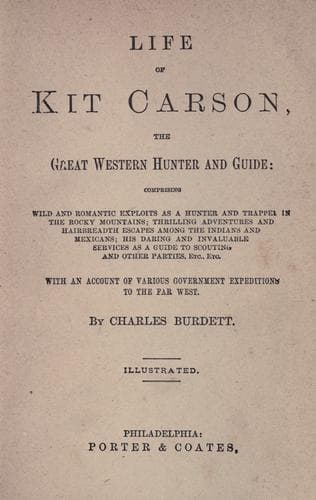
Life of Kit Carson, the Great Western Hunter and GuideBurdett, Charles
History
Life of Kit Carson, the Great Western Hunter and Guide
Burdett, Charles
Carson Kit, 1809-1868; Frontier and pioneer life -- West (U.S.)
Carson, in a letter to the Washington Union in June 1847, thus describes
the interview, and the events consequent upon it:
"Mr. Gillespie had brought the Colonel letters from home--the first he
had had since leaving the States the year before--and he was up, and
kept a large fire burning until after midnight; the rest of us were
tired out, and all went to sleep. This was the only night in all our
travels, except the one night on the island in the Salt Lake, that we
failed to keep guard; and as the men were so tired, and we expected no
attack now that we had sixteen in the party, the Colonel didn't like to
ask it of them, but sat up late himself. Owens and I were sleeping
together, and we were waked at the same time by the licks of the axe
that killed our men. At first, I didn't know it was that; but I called
to Basil, who was on that side--'What's the matter there?--What's that
fuss about?'--he never answered, for he was dead then, poor fellow, and
he never knew what killed him--his head had been cut in, in his sleep;
the other groaned a little as he died. The Delawares (we had four with
us) were sleeping at that fire, and they sprang up as the Tlamaths
charged them. One of them caught up a gun, which was unloaded; but,
although he could do no execution, he kept them at bay, fighting like a
soldier, and didn't give up until he was shot full of arrows--three
entering his heart; he died bravely. As soon as I had called out, I saw
it was Indians in the camp, and I and Owens together cried out
'Indians.' There were no orders given; things went on too fast, and the
Colonel had men with him that didn't need to be told their duty. The
Colonel and I, Maxwell, Owens, Godey, and Stepp, jumped together, we
six, and ran to the assistance of our Delawares. I don't know who fired
and who didn't; but I think it was Stepp's shot that killed the Tlamath
chief; for it was at the crack of Stepp's gun that he fell. He had an
English half-axe slung to his wrist by a cord, and there were forty
arrows left in his quiver--the most beautiful and warlike arrows I ever
saw. He must have been the bravest man among them, from the way he was
armed, and judging by his cap. When the Tlamaths saw him fall, they ran;
but we lay, every man with his rifle cocked, until daylight, expecting
another attack.
Public-domain text, read in full here on John Shaqi.
Reviews
Reviews
No reviews yet
Be the first to share your thoughts on this work.
Elsewhere in the archive
Join the Discussion
Join the discussion
Sign in to leave a comment or review.
Sign InorCreate an account