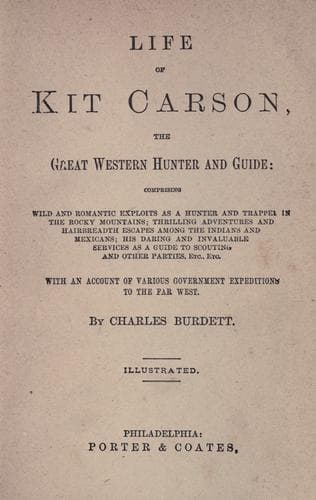
Life of Kit Carson, the Great Western Hunter and GuideBurdett, Charles
History
Life of Kit Carson, the Great Western Hunter and Guide
Burdett, Charles
Carson Kit, 1809-1868; Frontier and pioneer life -- West (U.S.)
They were not long in finding a trail, which they followed to a village
of fifty lodges, in each of which were probably three warriors. The
village was in commotion, which indicated that they had discovered
Carson and his party; so that no time could be lost, and Carson and his
comrades at once determined to take advantage of the confusion in which
the Indian camp seemed to be, by making a sudden charge.
The Indians had their families to defend, and were brave in proportion
as that motive is an incentive to activity, therefore the attack of the
white men was received and met with desperation. But a panic of fear
seized them, owing to the suddenness of the attack, and they fled,
leaving behind them all their possessions, while the victors pursued and
shot them down without mercy, and when the victory was declared complete
by their leader Carson, they returned to the richly-stored village. In
all their travels and adventures, they had never seen an Indian village
in which the lodges were more tasteful in their workmanship and their
decorations, or which were better supplied with utensils of convenience.
The wigwams were woven of the broad leaves of a kind of flag which was
highly combustible. Carson therefore ordered that they should be burned,
having first visited them to see that their contents were so arranged as
to be consumed in the conflagration. The work was completed in a few
moments and Fremont, seeing the smoke, knew that Carson was engaged
with the Indians, and hastened forward to render him any needed
assistance. But he arrived only to hear the report of his lieutenant,
and to have the gloom of the whole party dispelled by the news of the
victory accomplished; and to move on a little for an encampment, and a
talk in regard to their future operations.
The next day all started for the valley of the Sacramento, and were four
days out from their camp when they came to a point on the river where it
passes through a deep cañon, through which the trail would take them,
but Carson advised to avoid this gorge, and they were wise in doing so,
as Tlamath Indians were concealed there, intending to cut off the party
of white men. Disappointed that they had lost their prey, the Indians
came out from this ambush, and were immediately dispersed by Carson and
Godey, and a few others, who made a charge upon them. But one old
Indian, inspired probably by revenge for some friend lost, stood his
ground, and with several arrows in his mouth waited the attack he
courted. Carson and Godey advanced, and when within shooting distance,
were obliged to dodge rapidly to avoid the arrows leveled at them. The
Indian was behind a tree, and only by cautiously advancing while
dodging the death he was sending from his bow, did Carson gain a
position where he was able to aim a bullet at his heart. The beautiful
bow and still unexhausted quiver that Carson took from this Indian, he
presented to Lieutenant Gillespie on his return to camp.
Public-domain text, read in full here on John Shaqi.
Reviews
Reviews
No reviews yet
Be the first to share your thoughts on this work.
Elsewhere in the archive
Join the Discussion
Join the discussion
Sign in to leave a comment or review.
Sign InorCreate an account