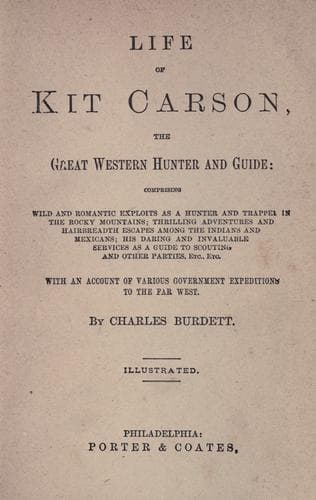
Life of Kit Carson, the Great Western Hunter and GuideBurdett, Charles
History
Life of Kit Carson, the Great Western Hunter and Guide
Burdett, Charles
Carson Kit, 1809-1868; Frontier and pioneer life -- West (U.S.)
The Mexicans found Col. Fremont, and laid down their arms to him,
probably preferring to give him the honor of the victory rather than
Gen. Kearney, though if this was or was not the motive, history now
sayeth not. Col. Fremont continued his march and came to Los Angelos,
and as the fighting for the present certainly was over, he and his men
rested here for the winter, where Carson, who had been rendering all the
aid in his power to Gen. Kearney, now gladly joined his old commander.
The position of the American forces, had the camps been harmonious, was
as comfortable and conducive to happiness during the winter as it was
possible for it to be, and the Mexican citizens of Los Angelos had been
so conciliated, the time might have passed pleasantly. But, as we have
intimated, Gen. Kearney had a general contempt for the Mexicans, and his
position in the camp forbade those pleasant civilities which had
commenced in San Diego before his arrival, and would have been
prosecuted in Los Angelos, to the advantage of all concerned; for, as
many of the men in Fremont's camp were old residents of the country, and
known and respected by the Mexican citizens, with whom some of them had
contracted intimate social relations, it is not wonderful that the
Mexican officers and soldiers chose to lay down their arms to him and
his command. Fremont had beside, at the instigation of Carson as well as
of his own inclination, taken every reasonable opportunity to gratify
their love of social life, by joining in their assemblies as opportunity
offered; and for this, as well as his magnanimous courage, we can
appreciate their choice in giving him the palm of victory.
CHAPTER XXIX.
Events transpire rapidly when a country is in a state of revolution.
Early in March of '46 the little party of explorers received the "first
hostile message" from General Castro--the _Commandant_ General of
California--which, though really a declaration of war, upon a party sent
out by the United States Government on a purely scientific expedition,
had been received and acted upon by Fremont with moderation, and actual
war had not been declared until July, when Sonoma was taken, and the
flag of Independence hoisted on the fourth of that month, and Fremont
elected Governor of California.
While hearing indefinitely of these events, Commodore Sloat, who, with
the vessels belonging to his command, was lying at Monterey, had hoisted
the flag of the United States over that city, anticipating any command
to do so on the part of his government, and anticipating also the
action of the commander of the British ship of war, sent for a similar
purpose, which arrived at Monterey on the 19th of July, under the
command of Sir George Seymour; one of whose officers, in a book
published by him after his return to England, describes the entrance of
Fremont and his party into Monterey as follows:
Public-domain text, read in full here on John Shaqi.
Reviews
Reviews
No reviews yet
Be the first to share your thoughts on this work.
Elsewhere in the archive
Join the Discussion
Join the discussion
Sign in to leave a comment or review.
Sign InorCreate an account