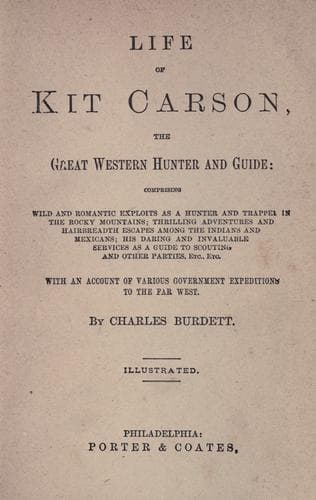
Life of Kit Carson, the Great Western Hunter and GuideBurdett, Charles
History
Life of Kit Carson, the Great Western Hunter and Guide
Burdett, Charles
Carson Kit, 1809-1868; Frontier and pioneer life -- West (U.S.)
Col. Fremont, in a letter written to his wife from Taos, the day after
his arrival there in a famishing condition, and having lost one full
third of his party by absolute starvation and freezing, mentions that
at Pueblo he engaged as a guide, an old trapper of twenty-five years,
experience, named "Bill Williams," and he frankly admits that the "error
of his journey was committed in engaging this man."
In narrating some of the incidents of this terribly disastrous journey,
we shall use, of course, the language of those best qualified to depict
its horrors, _i. e._, Col. Fremont, and Mr. Carvalho, a gentleman of
Baltimore, who accompanied the expedition as daguerreotypist and artist.
Col. Fremont, in his letter to his wife, treats of the subject
generally, but when we quote from the narrative of Mr. Carvalho, we
think our readers will admit that such a record of human suffering, and
human endurance, added to such an exhibition of moral and physical
courage, has never been paralleled.
Col. Fremont writes, (speaking first of Williams the guide,)
"He proved never to have in the least known, or entirely to have
forgotten, the whole region of country through which we were to pass. We
occupied more than half a month in making the journey of a few days,
blundering a tortuous way through deep snow which already began to choke
up the passes, for which we were obliged to waste time in searching.
About the 11th December we found ourselves at the North of the Del Norte
Cañon, where that river issues from the St. John's Mountain, one of the
highest, most rugged and impracticable of all the Rocky Mountain ranges,
inaccessible to trappers and hunters even in the summer time.
"Across the point of this elevated range our guide conducted us, and
having still great confidence in his knowledge, we pressed onwards with
fatal resolution. Even along the river bottoms the snow was already
belly deep for the mules, frequently snowing in the valley and almost
constantly in the mountains. The cold was extraordinary; at the warmest
hours of the day (between one and two) the thermometer (Fahrenheit)
standing in the shade of only a tree trunk at zero; the day sunshiny,
with a moderate breeze. We pressed up towards the summit, the snow
deepening; and in four or five days reached the naked ridges which lie
above the timbered country, and which form the dividing grounds between
the waters of the Atlantic and Pacific oceans.
Public-domain text, read in full here on John Shaqi.
Reviews
Reviews
No reviews yet
Be the first to share your thoughts on this work.
Elsewhere in the archive
Join the Discussion
Join the discussion
Sign in to leave a comment or review.
Sign InorCreate an account