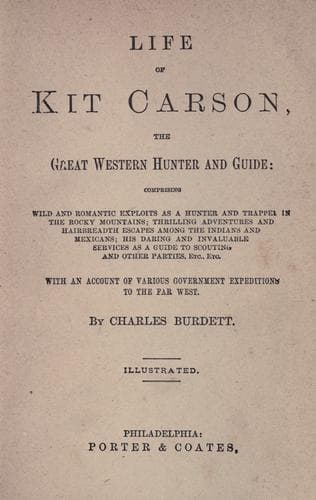
Life of Kit Carson, the Great Western Hunter and GuideBurdett, Charles
History
Life of Kit Carson, the Great Western Hunter and Guide
Burdett, Charles
Carson Kit, 1809-1868; Frontier and pioneer life -- West (U.S.)
"Capt. Pheiffer's party proceeded two days through the cañon, fighting
occasionally; but although the Indians frequently fired on them from
the rocky walls above, the balls were spent long before they reached the
bottom of the cañon, which, in many places, exceeded one thousand five
hundred feet in depth. It was a singular spectacle to behold. A small
detachment of troops moving cautiously along the bottom of one of the
greatest cañons on the globe, (the largest is in Asia, I believe,) and
firing volleys upward at hundreds of Navajoes, who looked, on the dizzy
height above them, like so many pigmies. As they advanced the cañon
widened in places, and various spots of cultivated land were passed,
where wheat, maize, beans, melons, etc., had been planted last year;
while more than a thousand feet above their heads they beheld
neat-looking stone houses built on the receding ledges of rocks, which
reminded the beholder of the swallows' nests in the house eaves, or on
the rocky formation overhanging the 'sea-beat caves.' Further on, an
orchard containing about six hundred peach-trees was passed, and it was
evident that the Indians had paid great attention to their culture.
"On the second day a party from Col. Carson's column met the Captain in
the cañon, and returned with him to Col. Carson's camp. A party from the
Colonel's command had, in the meantime, attacked a party of Indians,
twenty-two of whom were killed. This had a dispiriting effect on many
others, who sent in three of their number under a white flag. Col.
Carson received them, and assured them that the Government did not
desire to exterminate them, but that, on the contrary, the President
wished to save and civilize them; and to that end Gen. Carlton had given
him instructions to send all the Navajoes who desired peace to the new
reservation on the Rio Pecos, where they would be supplied with food for
the present, and be furnished with implements, seeds, etc., to cultivate
the soil. They departed well-satisfied, and Col. Carson immediately
ordered Capt. A. B. Carey, Thirteenth United States Infantry, with a
battalion to enter the cañon, and make a thorough exploration of its
various branches, and at the same time to be in readiness to chastise
any body of hostile Navajoes he might encounter, and to receive all who
were friendly, and who wished to emigrate to the new reservation. Capt.
Carey, during a passage of twenty-four hours through a branch of the
cañon hitherto unexplored, made an exact geographical map of this
terrible chasm, and discovered many side cañons hitherto unknown. About
one hundred Indians came in to him and declared that 'the Navajo nation
was no more;' that they were tired of fighting and nearly starved, and
that they wished to be permitted to advise their friends and families in
the mountains; many of whom were willing to leave the land forever, and
go to a country where they would be cared for and protected. They said
Public-domain text, read in full here on John Shaqi.
Reviews
Reviews
No reviews yet
Be the first to share your thoughts on this work.
Elsewhere in the archive
Join the Discussion
Join the discussion
Sign in to leave a comment or review.
Sign InorCreate an account