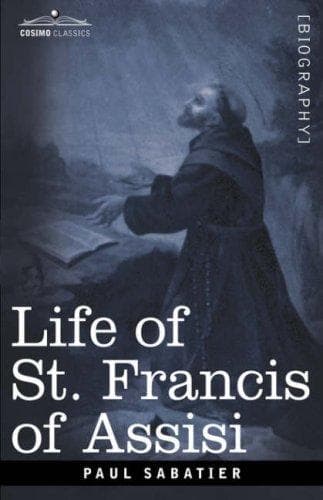
Christian saints -- Biography; Francis, of Assisi, Saint, 1182-1226
With St. Francis as with Jesus, prayer has this character of effort
which makes of it the greatest moral act. In order to truly know such
men one must have been able to go with them, to follow Jesus up to the
mountain where he passed his nights. Three favored ones, Peter, James,
John, followed him thither one day; but to describe what they saw, all
that a manly _sursum corda_ added to the radiance and the mysterious
grandeur of him whom they adored, they were obliged to resort to the
language of symbols.
It was so with St. Francis. For him as for his Master the end of prayer
is communion with the heavenly Father, the accord of the divine with the
human; or rather it is man who puts forth his strength to do the work of
God, not saying to him a mere passive, resigned, powerless _Fiat_, but
courageously raising his head: "Behold me, Lord, I delight to do thy
will."
"There are unfathomable depths in the human soul, because at the bottom
is God himself." Whether this God be transcendent or immanent, whether
he be One, the Creator, the eternal and immutable Principle, or whether
he be, as say the doctors beyond the Rhine, the ideal objectivation of
our Me, is not the question for the heroes of humanity. The soldier in
the thick of battle does not philosophize as to how much truth or
falsehood there is in the patriotic sentiment; he takes his arms and
fights at the peril of his life. So the soldiers of spiritual conflicts
seek for strength in prayer, in reflection, contemplation, inspiration;
all, poets, artists, teachers, saints, legislators, prophets, leaders of
the people, learned men, philosophers, all draw from this same source.
But it is not without difficulty that the soul unites itself to God, or
if one prefers, that it finds itself. A prayer ends at last in divine
communion only when it began by a struggle. The patriarch of Israel,
asleep near Bethel, had already divined this: the God who passes by
tells his name only to those who stop him and do him violence to learn
it. He blesses only after long hours of conflict.
The gospel has found an untranslatable word to characterize the prayers
of Jesus, it compares the conflict which preceded the voluntary
immolation of Christ to the death-struggle: _Factus in agonia_.[6] We
might say of his life that it had been a long temptation, a struggle, a
prayer, since these words only express different moments of spiritual
activity.
Like their Master, the disciples and successors of Christ can conquer
their own souls only through perseverance. But these words, empty of
meaning for devout conventicles, have had a tragic sense for men of
religious genius.
Public-domain text, read in full here on John Shaqi.
Reviews
Reviews
No reviews yet
Be the first to share your thoughts on this work.
Elsewhere in the archive
Join the Discussion
Join the discussion
Sign in to leave a comment or review.
Sign InorCreate an account