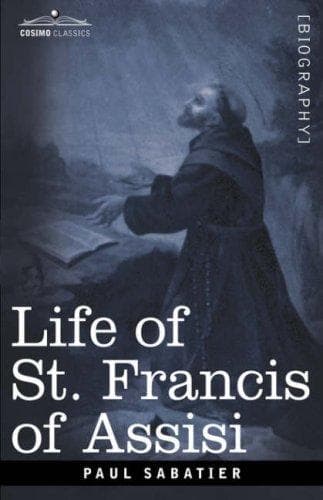
Christian saints -- Biography; Francis, of Assisi, Saint, 1182-1226
Religious formalism, in whatever form of worship, always takes on a
forced and morose manner. Pharisees of every age disfigure their faces
that no one may be unaware of their godliness. Francis not merely could
not endure these grimaces of false piety, he actually counted mirth and
joy in the number of religious duties.
How shall one be melancholy who has in the heart an inexhaustible
treasure of life and truth which only increases as one draws upon it?
How be sad when in spite of falls one never ceases to make progress?
The pious soul which grows and develops has a joy like that of the
child, happy in feeling its weak little limbs growing strong and
permitting it every day a further exertion.
The word joy is perhaps that which comes most often to the pen of the
Franciscan authors;[16] the master went so far as to make it one of the
precepts of the Rule.[17] He was too good a general not to know that a
joyous army is always a victorious army. In the history of the early
Franciscan missions there are bursts of laughter which ring out high and
clear.[18]
For that matter, we are apt to imagine the Middle Ages as much more
melancholy than they really were. Men suffered much in those days, but
the idea of grief being never separated from that of penalty, suffering
was either an expiation or a test, and sorrow thus regarded loses its
sting; light and hope shine through it.
Francis drew a part of his joy from the communion. He gave to the
sacrament of the eucharist that worship imbued with unutterable emotion,
with joyful tears, which has aided some of the noblest of human souls to
endure the burden and heat of the day.[19] The letter of the dogma was
not fixed in the thirteenth century as it is to-day, but all that is
beautiful, true, potent, eternal in the mystical feast instituted by
Jesus was then alive in every heart.
The eucharist was truly the viaticum of the soul. Like the pilgrims of
Emmaus long ago, in the hour when the shades of evening fall and a vague
sadness invades the soul, when the phantoms of the night awake and seem
to loom up behind all our thoughts, our fathers saw the divine and
mysterious Companion coming toward them; they drank in his words, they
felt his strength descending upon their hearts, all their inward being
warmed again, and again they whispered, "Abide with us, Lord, for the
day is far spent and the night approacheth."
And often their prayer was heard.
FOOTNOTES:
[1] 1 Cel., 62.
[2] 1 Cel., 66; cf. Bon., 180; 1 Cel., 67; cf. Bon., 182; 1
Cel., 69; Bon., 183. After St. Francis's death the Narniates
were the first to come to pray at his tomb. 1 Cel., 128, 135,
136, 138, 141; Bon., 275.
Public-domain text, read in full here on John Shaqi.
Reviews
Reviews
No reviews yet
Be the first to share your thoughts on this work.
Elsewhere in the archive
Join the Discussion
Join the discussion
Sign in to leave a comment or review.
Sign InorCreate an account