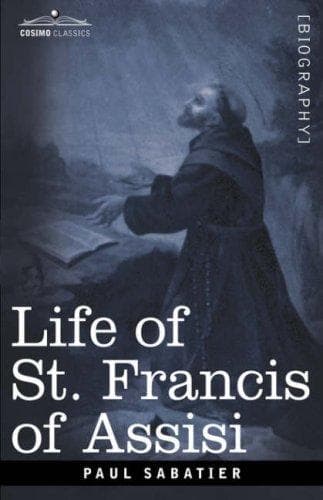
Christian saints -- Biography; Francis, of Assisi, Saint, 1182-1226
It would be a mistake to think, as some have done, that as time went on
Francis changed his point of view. Certain ecclesiastical writers have
assumed that since he desired the multiplication of his Order, he for
that very reason consented to its transformation. The suggestion is
specious, but in this matter we are not left to conjecture; almost
everything which was done in the Order after 1221 was done either
without Francis's knowledge or against his will. If one were inclined to
doubt this, it would need only to glance over that most solemn and also
most adequate manifesto of his thought--his Will. There he is shown
freed from all the temptations which had at times made him hesitate in
the expression of his ideas, bravely gathering himself up to summon back
the primitive ideal, and set it up in opposition to all the concessions
which had been wrung from his weakness.
The Will is not an appendix to the Rule of 1223, it is almost its
revocation. But it would be a mistake to see in it the first attempt
made to return to the early ideal. The last five years of his life were
only one incessant effort at protest, both by his example and his words.
In 1222 he addressed to the brethren of Bologna a letter filled with sad
forebodings. In that city, where the Dominicans, overwhelmed with
attentions, were occupied with making themselves a stronghold in the
system of instruction, the Brothers Minor were more than anywhere else
tempted to forsake the way of simplicity and poverty. Francis's warnings
had put on such dark and threatening colors that after the famous
earthquake of December 23, 1222, which spread terror over all northern
Italy, there was no hesitation in believing that he had predicted the
catastrophe.[9] He had indeed predicted a catastrophe which was none
the less horrible for being wholly moral, and the vision of which forced
from him the most bitter imprecations:
"Lord Jesus, thou didst choose thine apostles to the number of
twelve, and if one of them did betray thee, the others,
remaining united to thee, preached thy holy gospel, filled with
one and the same inspiration; and behold now, remembering the
former days, thou hast raised up the Religion of the Brothers in
order to uphold faith, and that by them the mystery of thy
gospel may be accomplished. Who will take their place if,
instead of fulfilling their mission and being shining examples
for all, they are seen to give themselves up to works of
darkness? Oh! may they be accursed by thee, Lord, and by all the
court of heaven, and by me, thine unworthy servant, they who by
their bad example overturn and destroy all that thou didst do in
the beginning and ceasest not to do by the holy Brothers of this
Order."[10]
This passage from Thomas of Celano, the most moderate of the
biographers, shows to what a pitch of vehemence and indignation the
gentle Francis could be worked up.
Public-domain text, read in full here on John Shaqi.
Reviews
Reviews
No reviews yet
Be the first to share your thoughts on this work.
Elsewhere in the archive
Join the Discussion
Join the discussion
Sign in to leave a comment or review.
Sign InorCreate an account