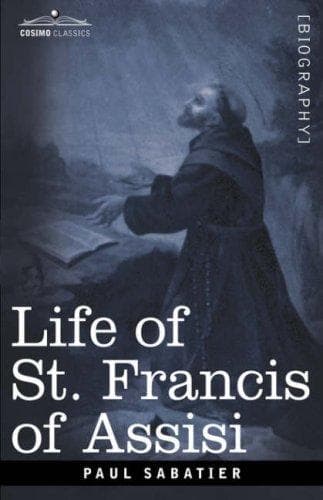
Christian saints -- Biography; Francis, of Assisi, Saint, 1182-1226
This promise reassured the worthy man, and when at the vintage he
received twenty measures, he had no hesitation in believing in a
miracle.[2]
Upon Ugolini's entreaties Francis had accepted the hospitality of the
bishop's palace in Rieti. Thomas of Celano enlarges with delight upon
the marks of devotion lavished on Francis by this prince of the Church.
Unhappily all this is written in that pompous and confused style of
which diplomats and ecclesiastics appear to have by nature the secret.
Francis entered into the condition of a relic in his lifetime. The mania
for amulets displayed itself around him in all its excesses. People
quarrelled not only over his clothing, but even over his hair and the
parings of his nails.[3]
Did these merely exterior demonstrations disgust him? Did he sometimes
think of the contrast between these honors offered to his body, which he
picturesquely called Brother Ass, and the subversion of his ideal? We
cannot tell. If he had feelings of this kind those who surrounded him
were not the men to understand them, and it would be idle to expect any
expression of them from his pen.
Soon after he had a relapse, and asked to be removed to
Monte-Colombo,[4] a hermitage an hour distant from the city, hidden
amidst trees and scattered rocks. He had already retired thither several
times, notably when he was preparing the Rule of 1223.
The doctors, having exhausted the therapeutic arsenal of the time,
decided to resort to cauterization; it was decided to draw a rod of
white-hot iron across his forehead.
When the poor patient saw them bringing in the brazier and the
instruments he had a moment of terror; but immediately making the sign
of the cross over the glowing iron, "Brother fire," he said, "you are
beautiful above all creatures; be favorable to me in this hour; you know
how much I have always loved you; be then courteous to-day."
Afterward, when his companions, who had not had the courage to remain,
came back he said to them, smiling, "Oh, cowardly folk, why did you go
away? I felt no pain. Brother doctor, if it is necessary you may do it
again."
This experiment was no more successful than the other remedies. In vain
they quickened the wound on the forehead, by applying plasters, salves,
and even by making incisions in it; the only result was to increase the
pains of the sufferer.[5]
One day, at Rieti, whither he had again been carried, he thought that a
little music would relieve his pain. Calling a friar who had formerly
been clever at playing the guitar, he begged him to borrow one; but the
friar was afraid of the scandal which this might cause, and Francis gave
it up.
Public-domain text, read in full here on John Shaqi.
Reviews
Reviews
No reviews yet
Be the first to share your thoughts on this work.
Elsewhere in the archive
Join the Discussion
Join the discussion
Sign in to leave a comment or review.
Sign InorCreate an account