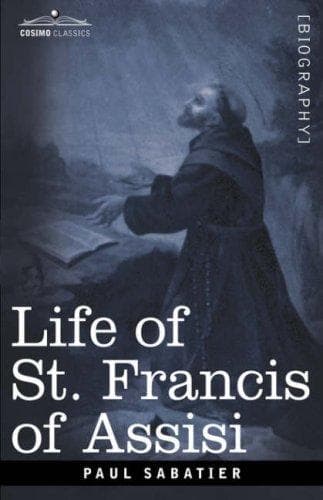
Christian saints -- Biography; Francis, of Assisi, Saint, 1182-1226
The dregs of this cup were spared him, thanks to an inspiration in which
breaks forth anew his natural play of imagination. To the Canticle of
the Sun he added a new strophe:
Be praised, Lord, for those who forgive for love of thee,
and bear trials and tribulations;
happy they who persevere in peace,
by thee, Most high, shall they be crowned.
Then, calling a friar, he charged him to beg the governor to betake
himself, with all the notables whom he could assemble, to the paved
square before the bishop's palace. The magistrate, to whom legend gives
the nobler part in the whole affair, at once yielded to the saint's
request.
When he arrived and the bishop had come forth from the palace,
two friars came forward and said: "Brother Francis has made to
the praise of God a hymn to which he prays you to listen
piously," and immediately they began to sing the Hymn of Brother
Sun, with its new strophe.
The governor listened, standing in an attitude of profound
attention, copiously weeping, for he dearly loved the blessed
Francis.
When the singing was ended, "Know in truth," said he, "that I
desire to forgive the lord bishop, that I wish and ought to look
upon him as my lord, for if one had even assassinated my brother
I should be ready to pardon the murderer." With these words he
threw himself at the bishop's feet, and said: "I am ready to do
whatsoever you would, for the love of our Lord Jesus Christ and
his servant Francis."
Then the bishop, taking him by the hand, lifted him up and said,
"With my position it would become me to be humble, but since I
am naturally too quick to wrath, thou must pardon me."[36]
This unexpected reconciliation was immediately looked upon as
miraculous, and increased still more the reverence of the Assisans for
their fellow-citizen.
The summer was drawing to a close. After a few days of relative
improvement Francis's sufferings became greater than ever: incapable of
movement, he even thought that he ought to give up his ardent desire to
see St. Damian and Portiuncula once more, and gave the brothers all his
directions about the latter sanctuary: "Never abandon it," he would
repeat to them, "for that place is truly sacred: it is the house of
God."[37]
It seemed to him that if the Brothers remained attached to that bit of
earth, that chapel ten feet long, those thatched huts, they would there
find the living reminder of the poverty of the early days, and could
never wander far from it.
Public-domain text, read in full here on John Shaqi.
Reviews
Reviews
No reviews yet
Be the first to share your thoughts on this work.
Elsewhere in the archive
Join the Discussion
Join the discussion
Sign in to leave a comment or review.
Sign InorCreate an account