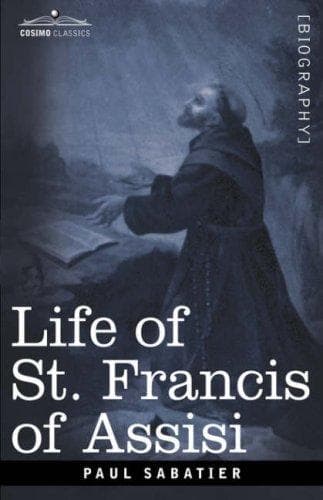
Christian saints -- Biography; Francis, of Assisi, Saint, 1182-1226
[40] _Spec._, 136b; _Fior. iv. consid._ It is to be noted that
Guido, instead of waiting at Assisi for the certainly impending
death of Francis, went away to Mont Gargano. 2 Cel., 3, 142.
* * * * *
CHAPTER XX
FRANCIS'S WILL AND DEATH
End of September-October 3, 1226
The last days of Francis's life are of radiant beauty. He went to meet
death, singing,[1] says Thomas of Celano, summing up the impression of
those who saw him then.
To be once more at Portiuncula after so long a detention at the bishop's
palace was not only a real joy to his heart, but the pure air of the
forest must have been much to his physical well-being; does not the
Canticle of the Creatures seem to have been made expressly to be sung in
the evening of one of those autumn days of Umbria, so soft and luminous,
when all nature seems to retire into herself to sing her own hymn of
love to Brother Sun?
We see that Francis has come to that almost entire cessation of pain,
that renewing of life, which so often precedes the approach of the last
catastrophe.
He took advantage of it to dictate his Will.[2]
It is to these pages that we must go to find the true note for a sketch
of the life of its author, and an idea of the Order as it was in his
dreams.
In this record, which is of an incontestable authenticity, the most
solemn manifestation of his thought, the Poverello reveals himself
absolutely, with a virginal candor.
His humility is here of a sincerity which strikes one with awe; it is
absolute, though no one could dream that it was exaggerated. And yet,
wherever his mission is concerned, he speaks with tranquil and serene
assurance. Is he not an ambassador of God? Does he not hold his message
from Christ himself? The genesis of his thought here shows itself to be
at once wholly divine and entirely personal. The individual conscience
here proclaims its sovereign authority. "No one showed me what I ought
to do, but the Most High himself revealed to me that I ought to live
conformably to his holy gospel."
When a man has once spoken thus, submission to the Church has been
singularly encroached upon. We may love her, hearken to her, venerate
her, but we feel ourselves, perhaps without daring to avow it, superior
to her. Let a critical hour come, and one finds himself heretic without
knowing it or wishing it.
"Ah, yes," cries Angelo Clareno, "St. Francis promised to obey the pope
and his successors, but they cannot and must not command anything
contrary to the conscience or to the Rule."[3]
For him, as for all the spiritual Franciscans, when there is conflict
between what the inward voice of God ordains and what the Church wills,
he has only to obey the former.[4]
If you tell him that the Church and the Order are there to define the
true signification of the Rule, he appeals to common sense, and to that
interior certitude which is given by a clear view of truth.
Public-domain text, read in full here on John Shaqi.
Reviews
Reviews
No reviews yet
Be the first to share your thoughts on this work.
Elsewhere in the archive
Join the Discussion
Join the discussion
Sign in to leave a comment or review.
Sign InorCreate an account