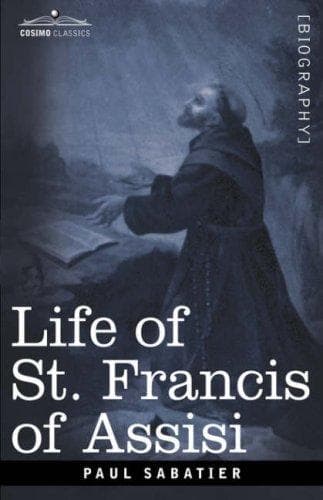
Christian saints -- Biography; Francis, of Assisi, Saint, 1182-1226
If it were necessary to point out the results of these two excesses as
they affect each event, this volume would need to be twice and even four
times as large as it is. Those who are interested in these questions
will find in the notes brief indications of the original documents on
which each narrative is based.[1]
To close the subject of the errors which are current in the Franciscan
documents, and to show in a few lines their extreme importance, I shall
take two examples. Among our own contemporaries no one has so well
spoken on the subject of St. Francis as M. Renan; he comes back to him
with affecting piety, and he was in a better condition than any one to
know the sources of this history. And yet he does not hesitate to say in
his study of the Canticle of the Sun, Francis's best known work: "The
authenticity of this piece appears certain, but we must observe that we
have not the Italian original. The Italian text which we possess is a
translation of a Portuguese version, which was itself translated from
the Spanish."[2]
And yet the primitive Italian exists[3] not only in numerous
manuscripts in Italy and France, particularly in the Mazarine
Library,[4] but also in the well-known book of the _Conformities_.[5]
An error, grave from quite another point of view, is made by the same
author when he denies the authenticity of St. Francis's Will; this piece
is not only the noblest expression of its author's religious feeling, it
constitutes also a sort of autobiography, and contains the solemn and
scarcely disguised revocation of all the concessions which had been
wrung from him. We have already seen that its authenticity is not to be
challenged.[6] This double example will, I hope, suffice to show the
necessity of beginning this study by a conscientious examination of the
sources.
If the eminent historian to whom I have alluded were still living, he
would have for this page his large and benevolent smile, that simple,
_Oui, oui_, which once made his pupils in the little hall of the College
de France to tremble with emotion.
I do not know what he would think of this book, but I well know that he
would love the spirit in which it was undertaken, and would easily
pardon me for having chosen him for scape-goat of my wrath against the
learned men and biographers.
The documents to be examined have been divided into five categories.
The first includes _St. Francis's works_.
The second, _biographies properly so called_.
The third, _diplomatic documents_.
The fourth, _chronicles of the Order_.
The fifth, _chronicles of authors not of the Order_.
FOOTNOTES:
[1] If any student finds himself embarrassed by the extreme
rarity of certain works cited, I shall make it my duty and
pleasure to send them to him, as well as a copy of the Italian
manuscripts.
[2] E. Renan: _Nouvelles etudes d'histoire religieuse_, Paris,
1884, 8vo, p. 331.
[3] See above, pp. 304 ff.
Public-domain text, read in full here on John Shaqi.
Reviews
Reviews
No reviews yet
Be the first to share your thoughts on this work.
Elsewhere in the archive
Join the Discussion
Join the discussion
Sign in to leave a comment or review.
Sign InorCreate an account